


 Cart
Cart
 sales@molnova.com



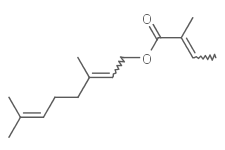
Geranyl?Tiglate
CAS No. 8000-46-2
Geranyl?Tiglate( —— )
Catalog No. M19114 CAS No. 8000-46-2
Geranium oil is one of the most important natural perfume.
Purity : >98% (HPLC)
 COA
Datasheet
HNMR
HPLC
MSDS
Handing Instructions
COA
Datasheet
HNMR
HPLC
MSDS
Handing Instructions
| Size | Price / USD | Stock | Quantity |
| 1 mL x 10 mM in DMSO | 28 | In Stock |


|
| 25MG | 28 | In Stock |
|
| 50MG | 33 | In Stock |
|
| 100MG | 40 | In Stock |
|
| 200MG | 55 | In Stock |
|
| 500MG | 91 | In Stock |
|
| 1G | 137 | In Stock |
|
Biological Information
-
Product NameGeranyl?Tiglate
-
NoteResearch use only, not for human use.
-
Brief DescriptionGeranium oil is one of the most important natural perfume.
-
DescriptionGeranium oil is one of the most important natural perfume.
-
In Vitro——
-
In Vivo——
-
Synonyms——
-
PathwayOthers
-
TargetOther Targets
-
RecptorOthers
-
Research Area——
-
Indication——
Chemical Information
-
CAS Number8000-46-2
-
Formula Weight236.36
-
Molecular FormulaC15H24O2
-
Purity>98% (HPLC)
-
Solubility——
-
SMILESC/C=C(\C)/C(=O)OC/C=C(\C)/CCC=C(C)C
-
Chemical Name——
Shipping & Storage Information
-
Storage(-20℃)
-
ShippingWith Ice Pack
-
Stability≥ 2 years
Reference



-
CALP1
Cell-permeable calmodulin (CaM) agonist that binds to the EF-hand/Ca2+-binding site; produces CaM-dependent activation of phosphodiesterase. Also binds to cytoplasmic sites on other Ca2+ channels, including NMDA and HIV-1 gp120-activated channels, inhibiting Ca2+-mediated cytotoxicity and apoptosis (IC50 = 52 μM). Shown to protect pancreatic acinar cells from gossypol induced necrosis. Inhibits VLA-5-mediated adhesion of mast cells to fibronectin in vitro and attenuates inflammatory cell influx in guinea pig lung in vivo.
-
Protein Kinase C (19...
Protein Kinase C (19-31) TFA, a peptide inhibitor of protein kinase C (PKC), derived from the pseudo-substrate regulatory domain of PKCa (residues 19-31) with a serine at position 25 replacing the wild-type alanine, is used as protein kinase C substrate peptide for testing the protein kinase C activity.
-
Traumatic Acid
Traumatic Acid is a product of the hydroperoxide lyase pathway in plants. Potential as a wound healing agent that stimulates cell division near a wound site to form a protective callus.
