


 Cart
Cart
 sales@molnova.com



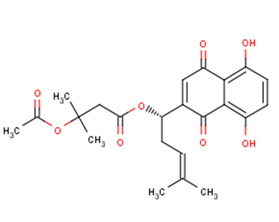
Acetoxyisovalerylalkannin
CAS No. 69091-17-4
Acetoxyisovalerylalkannin( —— )
Catalog No. M19002 CAS No. 69091-17-4
Beta-Acetoxyisovalerylshikonin is a naphthoquinone derivative isolated from Arnebia euchroma.
Purity : >98% (HPLC)
 COA
Datasheet
HNMR
HPLC
MSDS
Handing Instructions
COA
Datasheet
HNMR
HPLC
MSDS
Handing Instructions
| Size | Price / USD | Stock | Quantity |
| 1 mL x 10 mM in DMSO | 103 | In Stock |


|
| 5MG | 92 | In Stock |
|
| 10MG | 144 | In Stock |
|
| 25MG | 262 | In Stock |
|
| 50MG | 384 | In Stock |
|
| 100MG | 548 | In Stock |
|
| 200MG | 795 | In Stock |
|
| 500MG | Get Quote | In Stock |
|
| 1G | Get Quote | In Stock |
|
Biological Information
-
Product NameAcetoxyisovalerylalkannin
-
NoteResearch use only, not for human use.
-
Brief DescriptionBeta-Acetoxyisovalerylshikonin is a naphthoquinone derivative isolated from Arnebia euchroma.
-
DescriptionBeta-Acetoxyisovalerylshikonin is a naphthoquinone derivative isolated from Arnebia euchroma.
-
In Vitro——
-
In Vivo——
-
Synonyms——
-
PathwayOthers
-
TargetAntioxidant
-
RecptorOthers
-
Research Area——
-
Indication——
Chemical Information
-
CAS Number69091-17-4
-
Formula Weight430.45
-
Molecular FormulaC23H26O8
-
Purity>98% (HPLC)
-
SolubilityIn Vitro:?DMSO : 50 mg/mL (116.16 mM)
-
SMILESCC(=CCC(C1=CC(=O)C2=C(C=CC(=C2C1=O)O)O)OC(=O)CC(C)(C)OC(=O)C)C
-
Chemical Name——
Shipping & Storage Information
-
Storage(-20℃)
-
ShippingWith Ice Pack
-
Stability≥ 2 years
Reference
molnova catalog



related products
-
Methyl-β-cyclodextri...
Methyl-β-cyclodextrin, a cyclic heptasaccharide, is an effective agent for the depletion of cholesterol from cells; also inhibits PEL cell growth with an IC50 of 3.33-4.23 mM.
-
Valepotriate
Valepotriate fraction can have sedative effects and affect behavioral parameters related to recognition memory.
-
Idebenone
Idebenone is a synthetic analog of coenzyme Q10 (CoQ10) and a brain stimulant.
