


 Cart
Cart
 sales@molnova.com



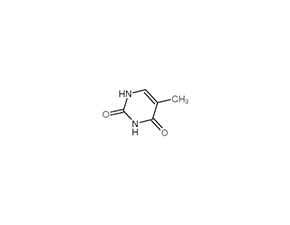
Thymine
CAS No. 65-71-4
Thymine( —— )
Catalog No. M18962 CAS No. 65-71-4
Thymine is found in the nucleic acid DNA. In RNA thymine is replaced with uracil in most cases. In DNA, thymine binds to adenine via two hydrogen bonds to assist in stabilizing the nucleic acid structures.
Purity : >98% (HPLC)
 COA
Datasheet
HNMR
HPLC
MSDS
Handing Instructions
COA
Datasheet
HNMR
HPLC
MSDS
Handing Instructions
| Size | Price / USD | Stock | Quantity |
| 1 mL x 10 mM in DMSO | 28 | In Stock |


|
| 100MG | Get Quote | In Stock |
|
| 200MG | Get Quote | In Stock |
|
| 500MG | 37 | In Stock |
|
| 1G | 43 | In Stock |
|
Biological Information
-
Product NameThymine
-
NoteResearch use only, not for human use.
-
Brief DescriptionThymine is found in the nucleic acid DNA. In RNA thymine is replaced with uracil in most cases. In DNA, thymine binds to adenine via two hydrogen bonds to assist in stabilizing the nucleic acid structures.
-
DescriptionOne of the pyrimidine bases of living matter. Derivation: Hydrolysis of deoxyribonucleic acid, from methylcyanoacetylurea by catalytic reduction. Use: Biochemical research. Thymine is a pyrimidine nucleobase. As the name implies, thymine may be derived by methylation of uracil at the 5th carbon. Thymine is found in the nucleic acid DNA. In RNA thymine is replaced with uracil in most cases. In DNA, thymine binds to adenine via two hydrogen bonds to assist in stabilizing the nucleic acid structures.
-
In Vitro——
-
In Vivo——
-
Synonyms——
-
PathwayOthers
-
TargetOther Targets
-
RecptorOthers
-
Research Area——
-
Indication——
Chemical Information
-
CAS Number65-71-4
-
Formula Weight126.11
-
Molecular FormulaC5H6N2O2
-
Purity>98% (HPLC)
-
SolubilityIn Vitro:?DMSO : 100 mg/mL (792.96 mM)
-
SMILESCC1=CNC(=O)NC1=O
-
Chemical Name——
Shipping & Storage Information
-
Storage(-20℃)
-
ShippingWith Ice Pack
-
Stability≥ 2 years
Reference
molnova catalog



related products
-
dITP trisodium salt
dITP trisodium salt (2'-Deoxyinosine-5'-triphosphate trisodium salt) is present in the hyperthermophilic bacterium Thermotoga maritima and can be used as a mutation reagent in mutagenesis PCR.
-
BI-6015
BI 6015 is an antagonist of HNF4α. HNF4α is a nuclear receptor that regulates gene expression in the intestine cells, liver cells, and pancreas-β cells.
-
Menisperine
Anti-inflammatory effects (potential NF-κB inhibitors).
