


 Cart
Cart
 sales@molnova.com



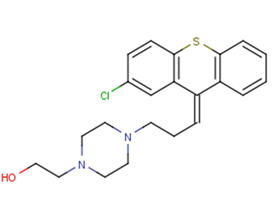
Zuclopenthixol
CAS No. 53772-83-1
Zuclopenthixol( alpha-Clopenthixol | Clopenthixol | Zuclopenthixol )
Catalog No. M18758 CAS No. 53772-83-1
Zuclopenthixol is a thioxanthene with therapeutic actions similar to the phenothiazine antipsychotics. It is an antagonist at D1 and D2 dopamine receptors.
Purity : >98% (HPLC)
 COA
Datasheet
HNMR
HPLC
MSDS
Handing Instructions
COA
Datasheet
HNMR
HPLC
MSDS
Handing Instructions
| Size | Price / USD | Stock | Quantity |
| 1 mL x 10 mM in DMSO | 28 | In Stock |


|
| 25MG | 29 | In Stock |
|
| 50MG | 36 | In Stock |
|
| 100MG | 51 | In Stock |
|
| 200MG | Get Quote | In Stock |
|
| 500MG | 124 | In Stock |
|
| 1G | 179 | In Stock |
|
Biological Information
-
Product NameZuclopenthixol
-
NoteResearch use only, not for human use.
-
Brief DescriptionZuclopenthixol is a thioxanthene with therapeutic actions similar to the phenothiazine antipsychotics. It is an antagonist at D1 and D2 dopamine receptors.
-
DescriptionZuclopenthixol, also known as Cisordinol, Clopixol, Acuphase, zuclopentixol, is a typical antipsychotic drug of the thioxanthene class. It was introduced in 1962 by Lundbeck. Zuclopenthixol is the cis-isomer of clopenthixol. Zuclopenthixol is not approved for use in the United States. Zuclopenthixol has high affinity for both dopamine D1 and D2 receptors, for α1-adrenoceptors and 5-HT2 receptors but no affinity for cholinergic muscarine receptors. It has weak histamine (H1) receptor affinity and no α2-adrenoceptor blocking activity.(In Vivo):After acute treatment, Zuclopenthixol (0.2 and 0.4 mg/kg)-treated animals exhibit ethopharmacological profiles characterized by a decrease in offensive behaviors without impairment of motor activity (0.2 mg/kg). In contrast, the antiaggressive action of the highest dose used (0.4 mg/kg) is accompanied by a marked increase of immobility. After subchronic treatment, no tolerance to Zuclopenthixol antiaggressive or motor activity is observed.Administration of Zuclopenthixol (0.7 and 1.4 mg/kg) significantly elevate MDA level compared to respective controls. Nevertheless, there is no difference between the two dose levels with respect to their effect on rat brain MDA level. Post hoc pairwise comparisons between the means of groups (n=12) receiving different dose levels of Zuclopenthixol reveal that administration of 1.4 mg/kg of Zuclopenthixol significantly reduces GSH level compared to both vehicle-treated and Zuclopenthixol (0.7 mg/kg)-treated animals (P<0.001). Nevertheless, the lower dose of the drug does not affect rat brain GSH level. Animals receiving 0.7 or 1.4 mg/kg of Zuclopenthixol exhibits significantly higher GSH levels than SCO treated animals. Administration of 0.7 mg/kg of Zuclopenthixol significantly elevated GSHPx activity compared to vehicle treated animals.
-
In Vitro——
-
In VivoAfter acute treatment, Zuclopenthixol (0.2 and 0.4 mg/kg)-treated animals exhibit ethopharmacological profiles characterized by a decrease in offensive behaviors without impairment of motor activity (0.2 mg/kg). In contrast, the antiaggressive action of the highest dose used (0.4 mg/kg) is accompanied by a marked increase of immobility. After subchronic treatment, no tolerance to Zuclopenthixol antiaggressive or motor activity is observed. Administration of Zuclopenthixol (0.7 and 1.4 mg/kg) significantly elevate MDA level compared to respective controls. Nevertheless, there is no difference between the two dose levels with respect to their effect on rat brain MDA level. Post hoc pairwise comparisons between the means of groups (n=12) receiving different dose levels of Zuclopenthixol reveal that administration of 1.4 mg/kg of Zuclopenthixol significantly reduces GSH level compared to both vehicle-treated and Zuclopenthixol (0.7 mg/kg)-treated animals (P<0.001). Nevertheless, the lower dose of the drug does not affect rat brain GSH level. Animals receiving 0.7 or 1.4 mg/kg of Zuclopenthixol exhibits significantly higher GSH levels than SCO treated animals. Administration of 0.7 mg/kg of Zuclopenthixol significantly elevated GSHPx activity compared to vehicle treated animals.
-
Synonymsalpha-Clopenthixol | Clopenthixol | Zuclopenthixol
-
PathwayOthers
-
TargetOther Targets
-
RecptorD1| D2
-
Research Area——
-
Indication——
Chemical Information
-
CAS Number53772-83-1
-
Formula Weight400.96
-
Molecular FormulaC22H25ClN2OS
-
Purity>98% (HPLC)
-
SolubilityDMSO : ≥ 150 mg/mL; 374.10 mM
-
SMILESC1CN(CCN1CC/C=C\1/c2ccccc2Sc2c1cc(cc2)Cl)CCO
-
Chemical Name2-[4-[(3Z)-3-(2-chlorothioxanthen-9-ylidene)propyl]piperazin-1-yl]ethanol
Shipping & Storage Information
-
Storage(-20℃)
-
ShippingWith Ice Pack
-
Stability≥ 2 years
Reference
1.Khalifa AE: Zuclopenthixol facilitates memory retrieval in rats: possible involvement of noradrenergic and serotonergic mechanisms. Pharmacol Biochem Behav. 2003 Jul;75(4):755-62.
molnova catalog



related products
-
RGD-4C
RGD-4C is a arginine-glycine-aspartic acid peptide (ACDCRGDCFC) with integrin binding activity. The Arg-Gly-Asp (RGD) sequence serves as the primary integrin recognition site in extracellular matrix proteins, and peptides containing this sequence can mimic the recognition specificity of the matrix proteins. RGD-4C is a αv-integrin ligand, can conjugate with bioactive molecule to exert antitumor effects in animal models.
-
Acetylvanillin
Vanillin is a phenolic aldehyde.
-
RS5517
RS5517 is a novel PDZ1 structural domain ligand for the study of colorectal cancer.
