


 Cart
Cart
 sales@molnova.com



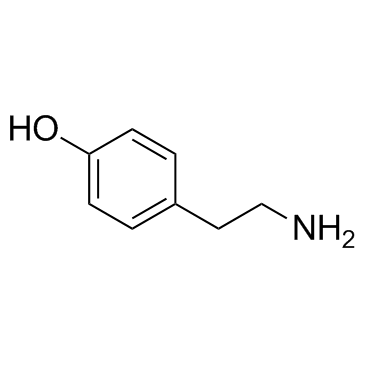
Tyramine
CAS No. 51-67-2
Tyramine( —— )
Catalog No. M18703 CAS No. 51-67-2
Tyramine is an indirect sympathomimetic that occurs naturally in cheese and other foods.
Purity : >98% (HPLC)
 COA
Datasheet
HNMR
HPLC
MSDS
Handing Instructions
COA
Datasheet
HNMR
HPLC
MSDS
Handing Instructions
| Size | Price / USD | Stock | Quantity |
| 1 mL x 10 mM in DMSO | 44 | In Stock |


|
| 100MG | Get Quote | In Stock |
|
| 200MG | Get Quote | In Stock |
|
| 500MG | 39 | In Stock |
|
| 1G | 47 | In Stock |
|
Biological Information
-
Product NameTyramine
-
NoteResearch use only, not for human use.
-
Brief DescriptionTyramine is an indirect sympathomimetic that occurs naturally in cheese and other foods.
-
DescriptionTyramine is an indirect sympathomimetic that occurs naturally in cheese and other foods. Tyramine does not directly activate adrenergic receptors, but it can serve as a substrate for adrenergic uptake systems and MONOAMINE OXIDASE to prolong the actions of adrenergic transmitters. It also provokes transmitter release from adrenergic terminals and may be a neurotransmitter in some invertebrate nervous systems.(In Vitro):Tyramine is normally broken down in your body by an enzyme called MAO (monoamine oxidase).
-
In VitroTyramine is normally broken down in your body by an enzyme called MAO (monoamine oxidase).
-
In Vivo——
-
Synonyms——
-
PathwayOthers
-
TargetOther Targets
-
RecptorMAOs
-
Research Area——
-
Indication——
Chemical Information
-
CAS Number51-67-2
-
Formula Weight137.18
-
Molecular FormulaC8H11NO
-
Purity>98% (HPLC)
-
SolubilityIn Vitro:?DMSO : 33.33 mg/mL (242.97 mM)
-
SMILESc1cc(ccc1CCN)O
-
Chemical Name——
Shipping & Storage Information
-
Storage(-20℃)
-
ShippingWith Ice Pack
-
Stability≥ 2 years
Reference
1. Grundemann D, et al. Nat Neurosci. 1998 Sep;1(5):349-51.
molnova catalog



related products
-
Lumichrome
Lumichrome is a natural metabolite of riboflavin. Lumichrome produced by Rhizobium and other bacterial species induces major developmental changes in plants at nanomolar concentrations. Lumichrome can stimulate larval metamorphosis in ascidians and activate the LasR quorum sensing receptor of bacteria.
-
Olanzapine impurity ...
Olanzapine impurity L HCl is an impurity generated during the production of Olanzapine.
-
[Glu3,4,7,10,14]-Con...
[Glu3,4,7,10,14]-Conantokin G
