


 Cart
Cart
 sales@molnova.com



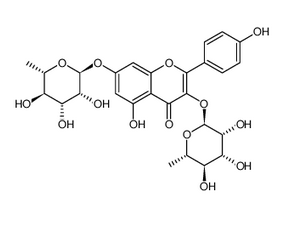
Kaempferitrin
CAS No. 482-38-2
Kaempferitrin( BRN 0073958 | Kaempferitrin | Kaempferol 3,7-bisrhamnoside )
Catalog No. M18620 CAS No. 482-38-2
Kaempferitrin has antidepressant-like effect related to the serotonergic system, principally 5-HT1A.
Purity : >98% (HPLC)
 COA
Datasheet
HNMR
HPLC
MSDS
Handing Instructions
COA
Datasheet
HNMR
HPLC
MSDS
Handing Instructions
| Size | Price / USD | Stock | Quantity |
| 1 mL x 10 mM in DMSO | 128 | In Stock |


|
| 5MG | 101 | In Stock |
|
| 10MG | 163 | In Stock |
|
| 25MG | 345 | In Stock |
|
| 50MG | 500 | In Stock |
|
| 100MG | 712 | In Stock |
|
| 200MG | 918 | In Stock |
|
| 500MG | Get Quote | In Stock |
|
| 1G | Get Quote | In Stock |
|
Biological Information
-
Product NameKaempferitrin
-
NoteResearch use only, not for human use.
-
Brief DescriptionKaempferitrin has antidepressant-like effect related to the serotonergic system, principally 5-HT1A.
-
DescriptionKaempferitrin has antidepressant-like effect related to the serotonergic system, principally 5-HT1A. Kaempferitrin exerts cytotoxic and antitumor effects against HeLa cells. Kaempferitrin stimulates glucose-metabolizing enzymes, promotes glucose homeostasis. Kaempferitrin exerts immunostimulatory effects on immune responses mediated by splenocytes, macrophages, PBMC and NK cells. Kaempferitrin induces cytotoxic effects to include: cell cycle arrest in G1 phase and apoptosis via the intrinsic pathway in a caspase-dependent pathway.
-
In VitroKaempferitrin activates insulin signaling pathway. Kaempferitrin causes survival rates higher than 90% at 1-20 μM in matured 3T3-L1 adipocyte, and the survival rates decline rapidly at 25 and 50 μM. Kaempferitrin (15 μM) increases insulin receptor beta tyrosine phosphorylation and tyrosine phosphorylation of the insulin receptor substrate 1, and such effects are similar to that of 10 nM insulin. Kaempferitrin (15 μM) also stimulates akt phosphorylation on ser473, and the stimulation can be blocked by a PI3-K inhibitor wortmannin. Kaempferitrin potently exerts the translocation of GLUT4 to the membrane of adipocytes at 15 μM, and this is suppressed by wortmannin. In addition, Kaempferitrin increases the total levels of Glu4 protein in differentiated cells and secreted adiponectin in mature 3T3-L1 adipocytes. Kaempferitrin is cytotoxic to human cancer cells such as HeLa and MDA-MB231 cells, with IC50s of 45 ± 2.6 and 65 ± 2.6 μM, and shows low toxic effects on non-tumorigenic cells. Kaempferitrin (45 μM) induces apoptosis of HeLa cells after treatment for 24 and 48 h, and causes reactive oxygen species (ROS) generation in HeLa cells. Furthermore, Kaempferitrin (45 μM) exerts G1 arrest, causes the expression of proteins associated with intrinsic pathway of apoptosis and activates caspase 3 in HeLa cells.
-
In VivoKaempferitrin (2.5, 10 and 25 mg/kg, i.p.) markedly suppresses the growth of tumor by 40%, 87% and 97%, and decreases tumor weight by 37%, 81% and 95%, respectively in nu/nu mice bearing HeLa tumor. Kaempferitrin also inhibits cell proliferation and extends life span in mice bearing tumor.
-
SynonymsBRN 0073958 | Kaempferitrin | Kaempferol 3,7-bisrhamnoside
-
PathwayApoptosis
-
TargetIL Receptor
-
Recptorcell cycle arrest| PFK
-
Research AreaOthers-Field
-
Indication——
Chemical Information
-
CAS Number482-38-2
-
Formula Weight578.5
-
Molecular FormulaC27H30O14
-
Purity>98% (HPLC)
-
SolubilityIn Vitro:?DMSO : 25 mg/mL (43.21 mM)
-
SMILESC[C@H]1[C@@H]([C@H]([C@H]([C@@H](O1)Oc1cc(c2c(c1)oc(c(c2=O)O[C@H]1[C@@H]([C@@H]([C@H]([C@@H](O1)C)O)O)O)c1ccc(O)cc1)O)O)O)O
-
Chemical Name4H-1-Benzopyran-4-one, 3,7-bis((6-deoxy-alpha-L-mannopyranosyl)oxy)-5-hydroxy-2-(4-hydroxyphenyl)-
Shipping & Storage Information
-
Storage(-20℃)
-
ShippingWith Ice Pack
-
Stability≥ 2 years
Reference
1. Da Silva D, et al. IUBMB Life. 2014 May;66(5):361-70.
molnova catalog



related products
-
Sarilumab
Sarilumab (SAR-153191)is a potent interleukin-6 IL-6 receptor antagonist and a human immunoglobulin G1 monoclonal antibody. Sarilumab inhibits IL-6-mediated signaling and reduces inflammation.Sarilumab is used for the prevention and treatment of rheumatoid arthritis.
-
GSK717
GSK717 is a potent and selective inhibitor of nucleotide-binding oligomerization domain 2 (NOD2). GSK717 blocks synergy between NOD2 and TLR2. GSK717 does not affect NOD1, TNFR1 and TLR2-mediated responses.
-
Skullcapflavone I
Skullcapflavone I can be isolated from A. nallamalayana. Skullcapflavone I inhibits collagenase and elastase enzyme with IC50s of 106.74 μM and 186.70 μM. Skullcapflavone I has anticancer activities by down-regulating miR-23a.
