


 Cart
Cart
 sales@molnova.com



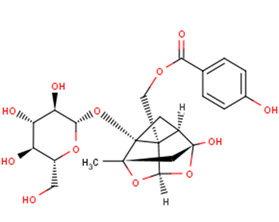
Oxypaeoniflorin
CAS No. 39011-91-1
Oxypaeoniflorin( —— )
Catalog No. M18513 CAS No. 39011-91-1
Oxypaeoniflorin is a natural product derived from Radix Paeoniae Rubra and Radix Paeoniae Alba.
Purity : >98% (HPLC)
 COA
Datasheet
HNMR
HPLC
MSDS
Handing Instructions
COA
Datasheet
HNMR
HPLC
MSDS
Handing Instructions
| Size | Price / USD | Stock | Quantity |
| 1 mL x 10 mM in DMSO | 166 | In Stock |


|
| 2MG | 76 | In Stock |
|
| 5MG | 136 | In Stock |
|
| 10MG | 239 | In Stock |
|
| 25MG | 430 | In Stock |
|
| 50MG | 620 | In Stock |
|
| 100MG | 883 | In Stock |
|
| 200MG | Get Quote | In Stock |
|
| 500MG | Get Quote | In Stock |
|
| 1G | Get Quote | In Stock |
|
Biological Information
-
Product NameOxypaeoniflorin
-
NoteResearch use only, not for human use.
-
Brief DescriptionOxypaeoniflorin is a natural product derived from Radix Paeoniae Rubra and Radix Paeoniae Alba.
-
DescriptionOxypaeoniflorin is a natural product derived from Radix Paeoniae Rubra and Radix Paeoniae Alba.
-
In VitroOxypaeoniflorin (OPA; 0.1-10 μM; 8 hours) obviously reversed the hypoxia/reoxygenation (H/R)-induced decrease in cell activity and increase in apoptosis of H9c2 cells. Oxypaeoniflorin inhibits apoptosis by activating the Sirt1 (silent information regulator factor 2 related enzyme 1)/Foxo1(forkhead transcription factor FKHR) signaling pathway in myocardial tissues and H9c2 cells. Oxypaeoniflorin (0-30 μM) attenuates inflammatory effects via regulation of the toll-like receptor (TLR), extracellular signal-related kinase (ERK) and p38 mitogen-activated protein (MAP) kinases signaling pathways in LPS-stimulated RAW264.7 cells.
-
In VivoOxypaeoniflorin (OPA; 10-40 mg/kg; intragastrical administration; every day; for 30 days) treatment significantly reduces disruption of cardiac function and improves the indicators of ejection fraction (EF) and fractional shortening (FS). Oxypaeoniflorin significantly reduces the release of myocardial infarction-related factors, such as the creatine kinase (CK-MB), cardiac troponin I (cTnI) and cardiac troponin T (cTnT). Animal Model: C57BL/6 male mice (6-8 weeks of age, 20-25 g) bearing myocardial ischemia/reperfusion (MI/R) injury Dosage:10 mg/kg, 20 mg/kg, 40 mg/kg Administration:Intragastrical administration; every day; for 30 days Result:Significantly reduced disruption of cardiac function and improved the indicators of ejection fraction (EF) and fractional shortening (FS).
-
Synonyms——
-
PathwayOthers
-
TargetOther Targets
-
RecptorOthers
-
Research AreaOthers-Field
-
Indication——
Chemical Information
-
CAS Number39011-91-1
-
Formula Weight496.46
-
Molecular FormulaC23H28O12
-
Purity>98% (HPLC)
-
SolubilityDMSO : 100 mg/mL 201.43 mM
-
SMILESC[C@]12C[C@@]3([C@@H]4C[C@]1([C@@]4([C@H](O2)O3)COC(=O)c1ccc(cc1)O)O[C@H]1[C@@H]([C@H]([C@@H]([C@H](O1)CO)O)O)O)O
-
Chemical Name——
Shipping & Storage Information
-
Storage(-20℃)
-
ShippingWith Ice Pack
-
Stability≥ 2 years
Reference
1. M. Kaneda, Tetrahedron Volume 28, Issue 16, 1972, Pages 4309-4317
molnova catalog



related products
-
Rhododendrol b
(+)-Rhododendrol ((S)-(+)-Rhododendrol) is an anti-inflammatory agent that can suppress NO production.
-
Amyloid Dan Protein ...
Amyloid Dan Protein (1-34) (reduced) trifluoroacetate salt/Amyloid Dan Protein Precursor??? (244-277) (reduced)
-
Monoethyl itaconate
Monoethyl itaconate is a free radical can be used for polymerization.
