


 Cart
Cart
 sales@molnova.com



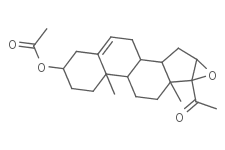
16,17-Epoxypregnenolone acetate
CAS No. 34209-81-9
16,17-Epoxypregnenolone acetate( —— )
Catalog No. M18445 CAS No. 34209-81-9
16, 17-Epoxypregnenolone acetate can be produced by Burkholderia cepacia SE-1.
Purity : >98% (HPLC)
 COA
Datasheet
HNMR
HPLC
MSDS
Handing Instructions
COA
Datasheet
HNMR
HPLC
MSDS
Handing Instructions
| Size | Price / USD | Stock | Quantity |
| 1 mL x 10 mM in DMSO | 28 | In Stock |


|
| 100MG | 40 | In Stock |
|
| 200MG | 73 | In Stock |
|
| 500MG | Get Quote | In Stock |
|
| 1G | Get Quote | In Stock |
|
Biological Information
-
Product Name16,17-Epoxypregnenolone acetate
-
NoteResearch use only, not for human use.
-
Brief Description16, 17-Epoxypregnenolone acetate can be produced by Burkholderia cepacia SE-1.
-
Description16, 17-Epoxypregnenolone acetate can be produced by Burkholderia cepacia SE-1.
-
In Vitro——
-
In Vivo——
-
Synonyms——
-
PathwayOthers
-
TargetOther Targets
-
RecptorOthers
-
Research Area——
-
Indication——
Chemical Information
-
CAS Number34209-81-9
-
Formula Weight372.5
-
Molecular FormulaC23H32O4
-
Purity>98% (HPLC)
-
Solubility——
-
SMILESC(=O)(C)O[C@@H]1CC2=CC[C@H]3[C@@H]4C[C@H]5O[C@]5([C@]4(CC[C@@H]3[C@]2(CC1)C)C)C(=O)C
-
Chemical Name——
Shipping & Storage Information
-
Storage(-20℃)
-
ShippingWith Ice Pack
-
Stability≥ 2 years
Reference
1. Zhu X, et al. Biomed Res Int. 2016;2016:5727631.
molnova catalog



related products
-
Bemnifosbuvir hemisu...
Bemnifosbuvir hemisulfate is a potent inhibitor of HCV virus replication.
-
GM-CSF
GM-CSF
-
Picrotin
Picrotin is an inhibitor of glycine receptors. Picrotin blocks α2 GlyR, α1 GlyR, and α3 GlyR and can be used in studies about neurotransmission.
