


 Cart
Cart
 sales@molnova.com



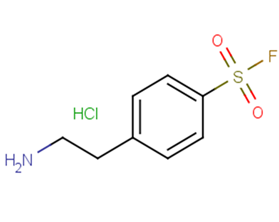
AEBSF hydrochloride
CAS No. 30827-99-7
AEBSF hydrochloride( —— )
Catalog No. M18403 CAS No. 30827-99-7
against HIV-1.
Purity : >98% (HPLC)
 COA
Datasheet
HNMR
HPLC
MSDS
Handing Instructions
COA
Datasheet
HNMR
HPLC
MSDS
Handing Instructions
| Size | Price / USD | Stock | Quantity |
| 1 mL x 10 mM in DMSO | 48 | In Stock |


|
| 25MG | 29 | In Stock |
|
| 50MG | 40 | In Stock |
|
| 100MG | 47 | In Stock |
|
| 200MG | 86 | In Stock |
|
| 500MG | Get Quote | In Stock |
|
| 1G | Get Quote | In Stock |
|
Biological Information
-
Product NameAEBSF hydrochloride
-
NoteResearch use only, not for human use.
-
Brief Descriptionagainst HIV-1.
-
Descriptionagainst HIV-1.
-
In VitroAEBSF inhibits the constitutive production of Aβ by directly inhibiting β-secretase in five different human cell lines, both neural and nonneural. AEBSF, as a serine protease inhibitor, inhibits the lysis of leukemic cells by human macrophages without inhibiting macrophage secretion of TNF-α and IL-1β. AEBSF also disturbs the growth of blastocysts on endometrial cells and inhibit the adhesion of HeLa cells on HUVECs by altering the protein secretion pattern.
-
In VivoAEBSF (76.8 mg/kg daily, i.p.) results in prolongation of the survival of mice that have been given a lethal T. gondii infection.AEBSF also reduces airway response and underlying inflammation in cockroach allergen-induced murine model.
-
Synonyms——
-
PathwayProteasome/Ubiquitin
-
TargetTyrosinase
-
RecptorSerine Protease
-
Research AreaOthers-Field
-
Indication——
Chemical Information
-
CAS Number30827-99-7
-
Formula Weight239.69
-
Molecular FormulaC8H11ClFNO2S
-
Purity>98% (HPLC)
-
SolubilityDMSO : 100 mg/mL 417.21 mM
-
SMILESc1cc(ccc1CCN)S(=O)(=O)F.Cl
-
Chemical Name——
Shipping & Storage Information
-
Storage(-20℃)
-
ShippingWith Ice Pack
-
Stability≥ 2 years
Reference
1. Citron M, et al. Neuron. 1996, 17(1), 171-179.
molnova catalog



related products
-
Tropolone
Tropolone a metal chelator possesses weak antioxidative and radical-scavenging properties and shows a strong affinity for ferric ion.
-
NDI-034858
NDI-034858 (TAK-279) is a tyrosine kinase 2 (TYK2) inhibitor (Kd<200 pM) that targets the JH2 structural domain of Tyk2 for the treatment of autoimmune diseases caused by aberrant expression of IL12 and IL23.
-
ME0328
ME0328 is a potent and selective PARP inhibitor with IC50 of 0.89 μM for PARP3, about 7-fold selectivity over PARP1.
