


 Cart
Cart
 sales@molnova.com



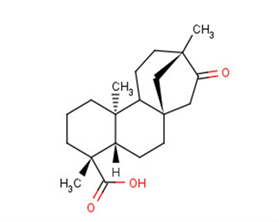
Isosteviol
CAS No. 27975-19-5
Isosteviol( (-)-Isosteviol | iso-Steviol )
Catalog No. M18354 CAS No. 27975-19-5
Isosteviol, a common natural sweetener, belongs to tetracyclic diterpene glycosides.
Purity : >98% (HPLC)
 COA
Datasheet
HNMR
HPLC
MSDS
Handing Instructions
COA
Datasheet
HNMR
HPLC
MSDS
Handing Instructions
| Size | Price / USD | Stock | Quantity |
| 1 mL x 10 mM in DMSO | 28 | In Stock |


|
| 100MG | 38 | In Stock |
|
| 200MG | Get Quote | In Stock |
|
| 500MG | 91 | In Stock |
|
| 1G | Get Quote | In Stock |
|
Biological Information
-
Product NameIsosteviol
-
NoteResearch use only, not for human use.
-
Brief DescriptionIsosteviol, a common natural sweetener, belongs to tetracyclic diterpene glycosides.
-
DescriptionIsosteviol, a common natural sweetener, belongs to tetracyclic diterpene glycosides. The pharmacology researches have suggested that stevioside and its hydrolysis products, steviol, isosteviol and steviolbioside, have many biological activities, such as reducing blood glucose, lowering blood pressure, anti-inflammation, anti-tumor, anti-diarrhea, antibacterium, immunoregulation, etc.(In Vitro):Isosteviol ((-)-Isosteviol) dose-dependently relaxed the vasopressin (10-8 M)-induced vasoconstriction in isolated aortic rings with or without endothelium. However, in the presence of potassium chloride (3×10⁻² M), the vasodilator effect of isosteviol on arterial strips disappeared. Only the inhibitors specific for the ATP-sensitive potassium (KATP) channel or small conductance calcium-activated potassium (SKCa) channel inhibited the vasodilator effect of isosteviol in isolated aortic rings contracted with 10-8 M vasopressin.The attenuation by isosteviol of the vasopressin- and phenylephrine-induced increase in [Ca2+]i was inhibited by glibenclamide, apamin and 4-aminopyridine but not by charybdotoxin. Furthermore, the inhibitory action of isosteviol on [Ca 2+]i was blocked when A7r5 cells co-treated with glibenclamide and apamin in conjunction with 4-aminopyridine were present.Isosteviol (1-100 micromol/l) inhibits angiotensin-II-induced DNA synthesis and endothelin-1 secretion. Measurements of 2'7'-dichlorofluorescin diacetate, a redox-sensitive fluorescent dye, showed an isosteviol-mediated inhibition of intracellular reactive oxygen species generated by the effects of angiotensin II.
-
In VitroIsosteviol ((-)-Isosteviol) dose-dependently relaxed the vasopressin (10-8 M)-induced vasoconstriction in isolated aortic rings with or without endothelium. However, in the presence of potassium chloride (3×10⁻² M), the vasodilator effect of isosteviol on arterial strips disappeared. Only the inhibitors specific for the ATP-sensitive potassium (KATP) channel or small conductance calcium-activated potassium (SKCa) channel inhibited the vasodilator effect of isosteviol in isolated aortic rings contracted with 10-8 M vasopressin. The attenuation by isosteviol of the vasopressin- and phenylephrine-induced increase in [Ca2+]i was inhibited by glibenclamide, apamin and 4-aminopyridine but not by charybdotoxin. Furthermore, the inhibitory action of isosteviol on [Ca 2+]i was blocked when A7r5 cells co-treated with glibenclamide and apamin in conjunction with 4-aminopyridine were present. Isosteviol (1-100 micromol/l) inhibits angiotensin-II-induced DNA synthesis and endothelin-1 secretion. Measurements of 2'7'-dichlorofluorescin diacetate, a redox-sensitive fluorescent dye, showed an isosteviol-mediated inhibition of intracellular reactive oxygen species generated by the effects of angiotensin II.
-
In Vivo——
-
Synonyms(-)-Isosteviol | iso-Steviol
-
PathwayOthers
-
TargetOther Targets
-
RecptorCOX-2| IL-6| NF-κB| Potassium Channel| TNF-α
-
Research AreaOthers-Field
-
Indication——
Chemical Information
-
CAS Number27975-19-5
-
Formula Weight318.45
-
Molecular FormulaC20H30O3
-
Purity>98% (HPLC)
-
SolubilityDMSO : ≥ 100 mg/mL; 314.02 mM
-
SMILESC[C@]12CCC3[C@@]4(CCC[C@@]([C@H]4CC[C@@]3(C1)CC2=O)(C)C(=O)O)C
-
Chemical Name——
Shipping & Storage Information
-
Storage(-20℃)
-
ShippingWith Ice Pack
-
Stability≥ 2 years
Reference
1. Wang Z, et al. Biochem Biophys Res Commun,2012, 417(4): 1280-1285.
molnova catalog



related products
-
Kavain
Kavain a compound extracted from the Kava plant Piper methysticum is found to be involved in TNF-α expression in human and mouse cells via regulation of transcriptional factors such as NF-kB and LITAF.
-
(Rac)-GSK 372475
(Rac)-GSK 372475 may be investigated for the treatment of Parkinson's syndrome, depression and obesity.
-
Lys-[Des-Arg9]Bradyk...
Lys-[Des-Arg9]Bradykinin,TFA is Endogenous potent and highly selective bradykinin B1 receptor agonist (Ki values are 0.12 and > 30000 nM at human B1 and B2 receptors respectively).
