


 Cart
Cart
 sales@molnova.com



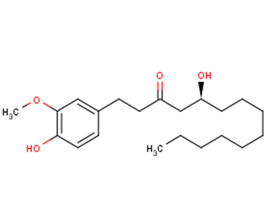
10-Gingerol
CAS No. 23513-15-7
10-Gingerol( 10-Gingerol )
Catalog No. M18280 CAS No. 23513-15-7
10-Gingerol-induced apoptosis was accompanied by phosphorylation of the mitogen-activated protein kinase (MAPKs) family, p38 MAPK (p38), c-Jun N-terminal kinase (JNK), and extracellular signal-regulated kinase (ERK).
Purity : >98% (HPLC)
 COA
Datasheet
HNMR
HPLC
MSDS
Handing Instructions
COA
Datasheet
HNMR
HPLC
MSDS
Handing Instructions
| Size | Price / USD | Stock | Quantity |
| 1 mL x 10 mM in DMSO | 53 | In Stock |


|
| 5MG | 68 | In Stock |
|
| 10MG | 93 | In Stock |
|
| 25MG | 160 | In Stock |
|
| 50MG | 232 | In Stock |
|
| 100MG | Get Quote | In Stock |
|
| 200MG | Get Quote | In Stock |
|
| 500MG | Get Quote | In Stock |
|
| 1G | Get Quote | In Stock |
|
Biological Information
-
Product Name10-Gingerol
-
NoteResearch use only, not for human use.
-
Brief Description10-Gingerol-induced apoptosis was accompanied by phosphorylation of the mitogen-activated protein kinase (MAPKs) family, p38 MAPK (p38), c-Jun N-terminal kinase (JNK), and extracellular signal-regulated kinase (ERK).
-
Description[10]-Gingerol is a bioactive compound found in ginger (Zingiber officinale) with anti-inflammatory and antioxidant activity.
-
In Vitro——
-
In Vivo——
-
Synonyms10-Gingerol
-
PathwayCell Cycle/DNA Damage
-
TargetAChR
-
RecptorApoptosis inducer
-
Research AreaOthers-Field
-
Indication——
Chemical Information
-
CAS Number23513-15-7
-
Formula Weight350.49
-
Molecular FormulaC21H34O4
-
Purity>98% (HPLC)
-
SolubilityIn Vitro:?DMSO : 100 mg/mL (285.31 mM)
-
SMILESC(CC(=O)C[C@H](CCCCCCCCC)O)c1cc(c(cc1)O)OC
-
Chemical Name(S)- 5-Hydroxy-1-(4-hydroxy-3-methoxyphenyl)-3-tetradecanone
Shipping & Storage Information
-
Storage(-20℃)
-
ShippingWith Ice Pack
-
Stability≥ 2 years
Reference
1.Ryu MJ1, Chung HS.[10]-Gingerol induces mitochondrial apoptosis through activation of MAPK pathway in HCT116 human colon cancer cells.In Vitro Cell Dev Biol Anim. 2015 Jan;51(1):92-101.
molnova catalog



related products
-
TMPH
TMPH is an inhibitor of nAChR and inhibits nAChRs lacking α5, α6, or β3 subunits. TMPH can be used in studies about nAChR dysfunction or neurological disorders.
-
Monepantel
Monepantel (AAD1566) is an organic anthelmintic and nicotinic acetylcholine receptor antagonist from roundworms and esophagostomies that is widely used for de-worming in agriculture and livestock.
-
SCH 57790
SCH 57790 is a novel and selective muscarinic M(2) receptor antagonist that releases acetylcholine and enhances cognition in experimental animals for the treatment of Alzheimer's disease.
