


 Cart
Cart
 sales@molnova.com



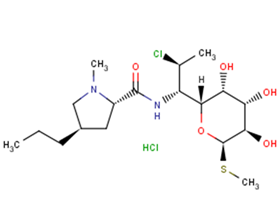
Clindamycin HCl
CAS No. 21462-39-5
Clindamycin HCl( —— )
Catalog No. M18238 CAS No. 21462-39-5
Clindamycin Hydrochloride inhibits protein synthesis by acting on the 50S ribosomal.
Purity : >98% (HPLC)
 COA
Datasheet
HNMR
HPLC
MSDS
Handing Instructions
COA
Datasheet
HNMR
HPLC
MSDS
Handing Instructions
| Size | Price / USD | Stock | Quantity |
| 1 mL x 10 mM in DMSO | 48 | In Stock |


|
| 50MG | 37 | In Stock |
|
| 100MG | 45 | In Stock |
|
| 200MG | 55 | In Stock |
|
| 500MG | Get Quote | In Stock |
|
| 1G | 85 | In Stock |
|
Biological Information
-
Product NameClindamycin HCl
-
NoteResearch use only, not for human use.
-
Brief DescriptionClindamycin Hydrochloride inhibits protein synthesis by acting on the 50S ribosomal.
-
DescriptionClindamycin Hydrochloride inhibits protein synthesis by acting on the 50S ribosomal. It is the hydrochloride salt form of clindamycin, a semi-synthetic, chlorinated broad-spectrum antibiotic produced by chemical modification of lincomycin. Clindamycin hydrochloride is used as a solid in capsules.(In Vitro):Clindamycin hydrochloride results in fast absorption after oral administration in dogs, with a mean absorption time (MAT) of 0.87 hour, and bioavailability is 72.55%. Clindamycin hydrochloride results in total clearance (CL) of Clindamycin after both IV and oral administration (0.503 vs. 0.458 L/h/kg) in dogs. Clindamycin hydrochloride results in volume of distribution at steady-state (IV) at 2.48 L/kg, indicating a wide distribution of clindamycin in body fluids and tissues. Clindamycin serum concentrations after IV and oral administration remain above 0.5 μg/mL approximately for 10 hours. Clindamycin hydrochloride significantly reduces oral malodor from the dogs' baseline levels through 42 days. Clindamycin hydrochloride also results in significant reductions in dental plaque, dental calculus, and gingival bleeding in dogs. Clindamycin hydrochloride (2.5 mg/Lb), after ultrasonic scaling, root planing, and polishing (USRP), has a significant effect on plaque and pocket depth measures of periodontal disease but not on gingivitis in canine. Clindamycin hydrochloride results in complete remission ratio of 71.4% (15/21) in dogs with canine superficial bacterial pyoderma after treat within 14 to 28 days.
-
In Vitro——
-
In Vivo——
-
Synonyms——
-
PathwayWnt/Notch/Hedgehog
-
TargetPorcupine
-
RecptorOthers
-
Research AreaInfection
-
Indication——
Chemical Information
-
CAS Number21462-39-5
-
Formula Weight461.44
-
Molecular FormulaC18H33ClN2O5S·HCl
-
Purity>98% (HPLC)
-
SolubilityDMSO : ≥ 43 mg/mL; 93.19 mM
-
SMILES[C@@H]1(O[C@@H]([C@@H]([C@H]([C@H]1O)O)O)SC)[C@H](NC(=O)[C@H]1N(C[C@@H](C1)CCC)C)[C@@H](Cl)C.Cl
-
Chemical Name——
Shipping & Storage Information
-
Storage(-20℃)
-
ShippingWith Ice Pack
-
Stability≥ 2 years
Reference
1. Batzias GC, et al. Vet J, 2005, 170(3), 339-345.
molnova catalog



related products
-
Wnt-C59
Wnt-C59(C59) is a very potent and highly selective Wnt signaling antagonist with an IC50 ~ 74 pM in the Wnt signaling reporter assay.
-
WNT-974
A potent and specific small-molecule Porcupine (PORCN) inhibitor with IC50 of 1 nM in the PORCN radioligand binding assay.
-
VEGFR2 KiN/Ase Inhib...
VEGFR2 Kinase Inhibitor I is a potent, cell-permeable inhibitor of the VEGFR2 kinase.
