


 Cart
Cart
 sales@molnova.com



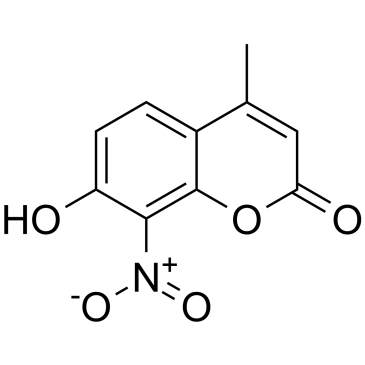
7-hydroxy-4-methyl-8-nitrocoumarin
CAS No. 19037-69-5
7-hydroxy-4-methyl-8-nitrocoumarin( —— )
Catalog No. M18166 CAS No. 19037-69-5
7-Hydroxy-4-methyl-8-nitrocoumarin is a coumarin derivative.
Purity : >98% (HPLC)
 COA
Datasheet
HNMR
HPLC
MSDS
Handing Instructions
COA
Datasheet
HNMR
HPLC
MSDS
Handing Instructions
| Size | Price / USD | Stock | Quantity |
| 25MG | 29 | In Stock |


|
| 50MG | 40 | In Stock |
|
| 100MG | 67 | In Stock |
|
| 200MG | Get Quote | In Stock |
|
| 500MG | 164 | In Stock |
|
| 1G | Get Quote | In Stock |
|
Biological Information
-
Product Name7-hydroxy-4-methyl-8-nitrocoumarin
-
NoteResearch use only, not for human use.
-
Brief Description7-Hydroxy-4-methyl-8-nitrocoumarin is a coumarin derivative.
-
Description7-Hydroxy-4-methyl-8-nitrocoumarin is a coumarin derivative.
-
In Vitro——
-
In Vivo——
-
Synonyms——
-
PathwayOthers
-
TargetOther Targets
-
RecptorOthers
-
Research Area——
-
Indication——
Chemical Information
-
CAS Number19037-69-5
-
Formula Weight221.16
-
Molecular FormulaC10H7NO5
-
Purity>98% (HPLC)
-
SolubilityIn Vitro:?DMSO : 5 mg/mL (22.61 mM)
-
SMILESCC1=CC(=O)OC2=C1C=CC(=C2[N+](=O)[O-])O
-
Chemical Name——
Shipping & Storage Information
-
Storage(-20℃)
-
ShippingWith Ice Pack
-
Stability≥ 2 years
Reference
molnova catalog



related products
-
Tilianin
Tilianin is a flavonoid glycoside of Dragocephalum moldavicum L.
-
Astragaloside A
Astragaloside A (Astragaloside IV) is the primary pure saponin isolated from Astragalus membranaceus, which has been widely used for the treatment of cardiovascular diseases.
-
TAT (48-57) TFA
TAT (48-57) (TFA) is a cellular permeability peptide derived from hiv-1 transcriptional activator (TAT) protein residue 48-57.
