


 Cart
Cart
 sales@molnova.com



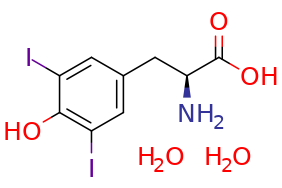
3,5-Diiodotyrosine Dihydrate
CAS No. 18835-59-1
3,5-Diiodotyrosine Dihydrate( —— )
Catalog No. M18163 CAS No. 18835-59-1
3, 5-Diiodotyrosine is a product from the iodination of monoiodotyrosine.
Purity : >98% (HPLC)
 COA
Datasheet
HNMR
HPLC
MSDS
Handing Instructions
COA
Datasheet
HNMR
HPLC
MSDS
Handing Instructions
| Size | Price / USD | Stock | Quantity |
| 1 mL x 10 mM in DMSO | 29 | In Stock |


|
| 100MG | Get Quote | In Stock |
|
| 200MG | Get Quote | In Stock |
|
| 500MG | Get Quote | In Stock |
|
| 1G | 27 | In Stock |
|
Biological Information
-
Product Name3,5-Diiodotyrosine Dihydrate
-
NoteResearch use only, not for human use.
-
Brief Description3, 5-Diiodotyrosine is a product from the iodination of monoiodotyrosine.
-
Description3, 5-Diiodotyrosine is a product from the iodination of monoiodotyrosine. In the biosynthesis of thyroid hormones, diiodotyrosine residues are coupled with other monoiodotyrosine or diiodotyrosine residues to form T4 or T3 thyroid hormones.
-
In Vitro——
-
In Vivo——
-
Synonyms——
-
PathwayOthers
-
TargetOther Targets
-
RecptorOthers
-
Research Area——
-
Indication——
Chemical Information
-
CAS Number18835-59-1
-
Formula Weight469.02
-
Molecular FormulaC9H13I2NO5
-
Purity>98% (HPLC)
-
SolubilityIn Vitro:?DMSO : 100 mg/mL (213.22 mM)
-
SMILESO.C(=O)([C@H](Cc1cc(c(c(c1)I)O)I)N)O.O
-
Chemical Name——
Shipping & Storage Information
-
Storage(-20℃)
-
ShippingWith Ice Pack
-
Stability≥ 2 years
Reference
1. Liu D, et al. Biol Trace Elem Res. 2015 Dec;168(2):447-52.
molnova catalog



related products
-
p60 v-src (137-157)
P60v-src(137-157) is a synthetic peptide that inhibits the tyrosine kinase activity of p60v-src (IC50: 7.5 μM).
-
Neurokinin B TFA
Neurokinin B TFA belongs to the tachykinin family.Neurokinin B binds to a series of GPCR, including neurokinin receptors 1 (NK1R), NK2R, and nk3r, to modulate their biological effects
-
Dansylglycine
Dansylglycine is a fluorescent probe for specific determination of halogenating activity of myeloperoxidase and eosinophil peroxidase.
