


 Cart
Cart
 sales@molnova.com



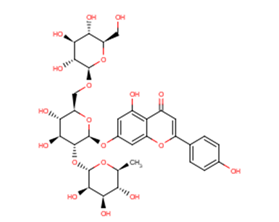
Apigenin 7-O-(2G-rhamnosyl)gentiobioside
CAS No. 174284-20-9
Apigenin 7-O-(2G-rhamnosyl)gentiobioside( —— )
Catalog No. M18123 CAS No. 174284-20-9
Apigenin-7-O-(2G-rhamnosyl)gentiobioside is a flavone glycosides from Lonicera gracilipes var. glandulosa.
Purity : >98% (HPLC)
 COA
Datasheet
HNMR
HPLC
MSDS
Handing Instructions
COA
Datasheet
HNMR
HPLC
MSDS
Handing Instructions
| Size | Price / USD | Stock | Quantity |
| 1 mL x 10 mM in DMSO | 124 | In Stock |


|
| 5MG | 183 | In Stock |
|
| 10MG | 275 | In Stock |
|
| 25MG | 465 | In Stock |
|
| 50MG | 649 | In Stock |
|
| 100MG | Get Quote | In Stock |
|
| 200MG | Get Quote | In Stock |
|
| 500MG | Get Quote | In Stock |
|
| 1G | Get Quote | In Stock |
|
Biological Information
-
Product NameApigenin 7-O-(2G-rhamnosyl)gentiobioside
-
NoteResearch use only, not for human use.
-
Brief DescriptionApigenin-7-O-(2G-rhamnosyl)gentiobioside is a flavone glycosides from Lonicera gracilipes var. glandulosa.
-
DescriptionApigenin-7-O-(2G-rhamnosyl)gentiobioside is a flavone glycosides from Lonicera gracilipes var. glandulosa.
-
In Vitro——
-
In Vivo——
-
Synonyms——
-
PathwayOthers
-
TargetOther Targets
-
RecptorOthers
-
Research Area——
-
Indication——
Chemical Information
-
CAS Number174284-20-9
-
Formula Weight740.67
-
Molecular FormulaC33H40O19
-
Purity>98% (HPLC)
-
SolubilityIn Vitro:?DMSO : 50 mg/mL (67.51 mM)
-
SMILESCC1C(C(C(C(O1)OC2C(C(C(OC2OC3=CC(=C4C(=C3)OC(=CC4=O)C5=CC=C(C=C5)O)O)COC6C(C(C(C(O6)CO)O)O)O)O)O)
-
Chemical Name——
Shipping & Storage Information
-
Storage(-20℃)
-
ShippingWith Ice Pack
-
Stability≥ 2 years
Reference
molnova catalog



related products
-
LC-2
LC-2 (PROTAC KRASG12C Degrader-LC-2) is a novel von Hippel-Lindau-based PROTAC degrader of endogenous KRAS G12C with a DC50 between 0.25 and 0.76 μM.
-
Jatrorrhizine hydroc...
Extracted from berberidis,radix.
-
Oleuropein
Oleuropein is an antioxidant polyphenol isolated from olive leaf.
