


 Cart
Cart
 sales@molnova.com



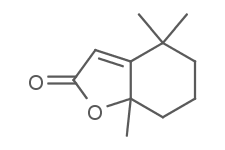
Dihydroactinidiolide
CAS No. 17092-92-1
Dihydroactinidiolide( —— )
Catalog No. M18118 CAS No. 17092-92-1
Dihydroactinidiolideis avolatileterpene. It has a sweet,tea-likeodorand is used as a fragrance.
Purity : >98% (HPLC)
 COA
Datasheet
HNMR
HPLC
MSDS
Handing Instructions
COA
Datasheet
HNMR
HPLC
MSDS
Handing Instructions
| Size | Price / USD | Stock | Quantity |
| 50MG | 40 | In Stock |


|
| 100MG | 61 | In Stock |
|
| 200MG | 87 | In Stock |
|
| 500MG | 142 | In Stock |
|
| 1G | Get Quote | In Stock |
|
Biological Information
-
Product NameDihydroactinidiolide
-
NoteResearch use only, not for human use.
-
Brief DescriptionDihydroactinidiolideis avolatileterpene. It has a sweet,tea-likeodorand is used as a fragrance.
-
DescriptionDihydroactinidiolideis avolatileterpene. It has a sweet,tea-likeodorand is used as a fragrance.
-
In Vitro——
-
In Vivo——
-
Synonyms——
-
PathwayChromatin/Epigenetic
-
TargetEpigenetic Reader Domain
-
RecptorOthers
-
Research Area——
-
Indication——
Chemical Information
-
CAS Number17092-92-1
-
Formula Weight180.24
-
Molecular FormulaC11H16O2
-
Purity>98% (HPLC)
-
SolubilityIn Vitro:?DMSO : 100 mg/mL (554.82 mM)
-
SMILESCC1(CCC[C@@]2(C1=CC(=O)O2)C)C
-
Chemical Name——
Shipping & Storage Information
-
Storage(-20℃)
-
ShippingWith Ice Pack
-
Stability≥ 2 years
Reference
1. Shumbe L, et al. Dihydroactinidiolide, a high light-induced β-carotene derivative that can regulate gene expression and photoacclimation in Arabidopsis. Mol Plant. 2014 Jul;7(7):1248-51.
molnova catalog



related products
-
PBRM1-BD2-IN-8
PBRM1-BD2-IN-8 (compound 34) is a potent PBRM1 Bromodomain inhibitor with PBRM1-BD2 Kd of 4.4 μM, PBRM1-BD2 IC50 of 0.16 μM, and PBRM1-BD5 Kd of 25 μM; PBRM1-BD2-IN-8 shows anti-cancer activity.
-
ODM-207
BET-IN-4 is a potent BRD4 inhibitor.
-
SR-0813
SR-0813 is a potent and selective inhibitor of the YEATS domain in ENL/AF9, with an IC50 of 25 nM and EC50 of 205 nM for the ENL YEATS domain, and an IC50 of 311 nM and EC50 of 76 nM (CETSA) for the AF9 YEATS domain.
