


 Cart
 sales@molnova.com




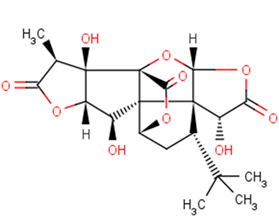
Ginkgolide B
CAS No. 15291-77-7
Ginkgolide B( Bilobalide B | Ginkgolide B | BN 52021 )
Catalog No. M18066 CAS No. 15291-77-7
Ginkgolide B is a PAFR antagonist(IC50=3.6 μM) isolated from Ginkgo biloba.
Purity : >98% (HPLC)
 COA
Datasheet
HNMR
HPLC
MSDS
Handing Instructions
| Size | Price / USD | Stock | Quantity |
| 1 mL x 10 mM in DMSO | 60 | In Stock |


|
| 5MG | 29 | In Stock |
|
| 10MG | 35 | In Stock |
|
| 25MG | 54 | In Stock |
|
| 50MG | 90 | In Stock |
|
| 100MG | 128 | In Stock |
|
| 200MG | Get Quote | In Stock |
|
| 500MG | 321 | In Stock |
|
| 1G | Get Quote | In Stock |
|
Biological Information
-
Product NameGinkgolide B
-
NoteResearch use only, not for human use.
-
Brief DescriptionGinkgolide B is a PAFR antagonist(IC50=3.6 μM) isolated from Ginkgo biloba.
-
DescriptionGinkgolide B is a GlyR agonist found in Ginkgo. It inhibits ATP release from thrombin-activated platelets, protects neurons against ischemic injury, prevents edema and inflammation, and increases activation of PKA, Ca+2 signaling, and glutamate release.
-
In VitroWestern Blot Analysis Cell Line:HUVECs Concentration:30, 60, 150 μM Incubation Time:24 hResult:Inhibited the up-regulation of VCAM-1 and E-selectin protein expression induced by TNF-α.RT-PCRCell Line:HUVECs Concentration:30, 60, 150 μM Incubation Time:24, 48 h Result:Increased CYP3A4 mRNA and MDR1 expression after 24 h, and this effect was dose-dependent after 48 h.
-
In VivoAnimal Model:Male clean healthy Sprague-Dawley rats, weighing 250-280 g and aged 8 weeksDosage:20 mg/kg Administration:Intraperitoneally; immediately and 6 hours after ischemia, and thereafter once daily; 14 days Result:Decreased the neurological deficit score, increased the proportion of nestin-, neuron-specific enolase- and glial fibrillary acid protein-positive cells. Caused down-regulation of NSE protein at day 14.
-
SynonymsBilobalide B | Ginkgolide B | BN 52021
-
PathwayOthers
-
TargetOther Targets
-
RecptorPAFR
-
Research AreaOthers-Field
-
Indication——
Chemical Information
-
CAS Number15291-77-7
-
Formula Weight424.4
-
Molecular FormulaC20H24O10
-
Purity>98% (HPLC)
-
SolubilityDMSO : ≥ 30 mg/mL; 70.69 mM
-
SMILESO1[C@H]2[C@@H](O)[C@]34[C@@H]5OC(=O)[C@]3(O[C@@H]3OC(=O)[C@H](O)[C@]43[C@H](C(C)(C)C)C5)[C@@]2(O)[C@H](C)C1=O
-
Chemical Name5H-Dicyclopenta(b,c)furan-3,5a(6H)-diacetic acid, 6-tert-butyl-3a-carboxyhexahydro-alpha5a,1,2,3,5,8-hexahydroxy-alpha3-methyl-, tri-gamma-lactone
Shipping & Storage Information
-
Storage(-20℃)
-
ShippingWith Ice Pack
-
Stability≥ 2 years
Reference


-
Desacetyl Forskolin
Deacetylforskolin is a deacetylated derivative of forskolin that can be extracted from C. forskohlii. Deacetylforskolin activates rat adipocyte adenylyl cyclase (IC50 = 20 μM), inhibits glucose transport in rat adipocyte plasma membranes and exhibits antihypertensive activity.
-
Taltirelin
Taltirelin is at thyrotropin-releasing hormone receptor (TRH-R) superagonist (IC50 of 910 nM and EC50 of 36 nM for stimulating an increase in cytosolic Ca2+ concentration (Ca2+ release).
-
γ-2-MSH (41-58), ami...
Melanocortin (MC) 3-MSH (Melanocyte-Stimulating Hormone) is believed to signal through the MC 3 receptor. It induces a sustained increase in intracellular free calcium levels ([Ca2+]i) in a subpopulation of pituitary cells. Most of the cells responding to 3-MSH express more than one pituitary hormone mRNA. The effect of 3-MSH is blocked by SHU9119, a MC3R and MC4R antagonist, in only 50% of the responsive cells, suggesting that in half of these cells the mediating receptor is not the MC3R. Low picomolar doses of 3-MSH increase [Ca2+]i in the growth hormone (GH)- and prolactin (PRL)-secreting GH3 cell line.
