


 Cart
Cart
 sales@molnova.com



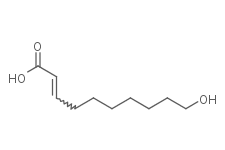
Royal Jelly acid
CAS No. 14113-05-4
Royal Jelly acid( —— )
Catalog No. M18005 CAS No. 14113-05-4
10-Hydroxy-2-decenoic acid is an inhibitor of VEGF-induced angiogenesis, cell migration and proliferation.
Purity : >98% (HPLC)
 COA
Datasheet
HNMR
HPLC
MSDS
Handing Instructions
COA
Datasheet
HNMR
HPLC
MSDS
Handing Instructions
| Size | Price / USD | Stock | Quantity |
| 1 mL x 10 mM in DMSO | 32 | In Stock |


|
| 25MG | 29 | In Stock |
|
| 50MG | 40 | In Stock |
|
| 100MG | 58 | In Stock |
|
| 200MG | Get Quote | In Stock |
|
| 500MG | 118 | In Stock |
|
| 1G | Get Quote | In Stock |
|
Biological Information
-
Product NameRoyal Jelly acid
-
NoteResearch use only, not for human use.
-
Brief Description10-Hydroxy-2-decenoic acid is an inhibitor of VEGF-induced angiogenesis, cell migration and proliferation.
-
Description10-Hydroxy-2-decenoic acid is an inhibitor of VEGF-induced angiogenesis, cell migration and proliferation.
-
In Vitro——
-
In Vivo——
-
Synonyms——
-
PathwayMicrobiology/Virology
-
TargetHIV
-
RecptorOthers
-
Research Area——
-
Indication——
Chemical Information
-
CAS Number14113-05-4
-
Formula Weight186.25
-
Molecular FormulaC10H18O3
-
Purity>98% (HPLC)
-
SolubilityIn Vitro:?DMSO : 100 mg/mL (536.91 mM)
-
SMILESC(CCC/C=C/C(=O)O)CCCO
-
Chemical Name——
Shipping & Storage Information
-
Storage(-20℃)
-
ShippingWith Ice Pack
-
Stability≥ 2 years
Reference
1. Yang XH, et al. Comparative proteomic analysis provides insight into 10-hydroxy-2-decenoic acid biosynthesis in honey bee workers. Amino Acids. 2017 Apr 17.
molnova catalog



related products
-
YIR-819
YIR-819 is a small-molecule CD4 mimic that acts as a highly potent HIV entry inhibitor.
-
Zidovudine
A nucleoside reverse transcriptase inhibitor (NRTI) that used to prevent and treat HIV/AIDS.
-
(±)-BI-D
A potent, allosteric HIV integrase inhibitor (Kd=34 nM) that binds the LEDGF/p75 binding site on integrase.
