


 Cart
Cart
 sales@molnova.com



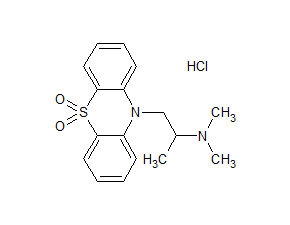
Dioxopromethazine
CAS No. 13754-56-8
Dioxopromethazine( —— )
Catalog No. M17984 CAS No. 13754-56-8
Dioxopromethazine is a drug for the treatment of a cough and expectoration. It also can be used in local anesthesia.
Purity : >98% (HPLC)
 COA
Datasheet
HNMR
HPLC
MSDS
Handing Instructions
COA
Datasheet
HNMR
HPLC
MSDS
Handing Instructions
| Size | Price / USD | Stock | Quantity |
| 100MG | 45 | In Stock |


|
| 200MG | 53 | In Stock |
|
| 500MG | Get Quote | In Stock |
|
| 1G | Get Quote | In Stock |
|
Biological Information
-
Product NameDioxopromethazine
-
NoteResearch use only, not for human use.
-
Brief DescriptionDioxopromethazine is a drug for the treatment of a cough and expectoration. It also can be used in local anesthesia.
-
DescriptionDioxopromethazine is a drug for the treatment of a cough and expectoration. It also can be used in local anesthesia.
-
In Vitro——
-
In Vivo——
-
Synonyms——
-
PathwayGPCR/G Protein
-
TargetAntibacterial
-
RecptorOthers
-
Research Area——
-
Indication——
Chemical Information
-
CAS Number13754-56-8
-
Formula Weight316.42
-
Molecular FormulaC17H20N2O2S
-
Purity>98% (HPLC)
-
Solubility——
-
SMILESCC(CN1c2ccccc2S(=O)(=O)c2ccccc12)N(C)C
-
Chemical Name——
Shipping & Storage Information
-
Storage(-20℃)
-
ShippingWith Ice Pack
-
Stability≥ 2 years
Reference
molnova catalog



related products
-
Sancycline
A semi-synthetic tetracycline prepared by hydrogenolysis of the chloro and benzylic hydroxy moieties of Declomycin.
-
Bisdionin C
Bisdionin C is a potent inhibitor of GH18 chitinase with an IC50 of 0.2 μM for A. fumigatus ChiB1. Bisdionin C inhibits human macrophage chitotriosidase(HCHT, IC50 = 8.3 μM) and acidic mammalian chitinase (AMCase, IC50 = 3.4 μM).
-
Trichloroisocyanuric...
The compound is a disinfectant algicide and bactericide mainly for swimming pools and dyestuffs and is also used as a bleaching agent in the textile industry.
