


 Cart
Cart
 sales@molnova.com



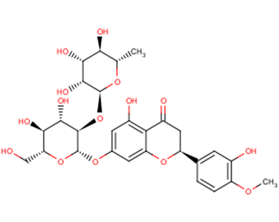
Neohesperidin
CAS No. 13241-33-3
Neohesperidin( Neohesperidin | Hesperetin 7-Neohesperidoside | NSC 31048 )
Catalog No. M17949 CAS No. 13241-33-3
Neohesperidin with antioxidant and neuroprotective properties.
Purity : >98% (HPLC)
 COA
Datasheet
HNMR
HPLC
MSDS
Handing Instructions
COA
Datasheet
HNMR
HPLC
MSDS
Handing Instructions
| Size | Price / USD | Stock | Quantity |
| 1 mL x 10 mM in DMSO | 41 | In Stock |


|
| 50MG | 36 | In Stock |
|
| 100MG | 47 | In Stock |
|
| 200MG | Get Quote | In Stock |
|
| 500MG | 176 | In Stock |
|
| 1G | 290 | In Stock |
|
Biological Information
-
Product NameNeohesperidin
-
NoteResearch use only, not for human use.
-
Brief DescriptionNeohesperidin with antioxidant and neuroprotective properties.
-
DescriptionNeohesperidin is a flavonoid found in citrus fruit peel that has diverse biological activities. Neohesperidin Exerts Lipid-Regulating Effects in vitro and in vivo via Fibroblast Growth Factor 21 and AMP-Activated Protein Kinase/Sirtuin Type 1/Peroxisome Proliferator-Activated Receptor Gamma Coactivator 1α Signaling Axis. Neohesperidin suppresses osteoclast differentiation, bone resorption and ovariectomised-induced osteoporosis in mice.(In Vitro):Neohesperidin induces cell apoptosis in human breast adenocarcinoma MDA-MB-231 cells. The IC50 values of neohesperidin at 24 and 48 h are 47.4±2.6 μM and 32.5±1.8 μM, respectively. The expressions of P53 and Bax in the neohesperidin-treated cells are significantly up-regulated, while that of Bcl-2 is down-regulated. Neohesperidin exhibits antioxidant activity (IC50=22.31 μg/mL) in the DPPH radical-scavenging assay.(In Vivo):Neohesperidin (50 mg/kg) significantly inhibits 55.0% of HCl/ethanol-induced gastric lesions. In pylorus ligated rats, neohesperidin (50 mg/kg) significantly decreases the volume of gastric secretion and gastric acid output, and increases the pH. Treatment of neohesperidin significantly decreases fasting glucose, serum glucose, and glycosylated serum protein (GSP) in mice. It significantly elevates oral glucose tolerance and insulin sensitivity and decreases insulin resistance in the diabetic mice. Neohesperidin significantly decreases serum triglycerides, total cholesterol, leptin level, and liver index in the mice.
-
In VitroNeohesperidin induces cell apoptosis in human breast adenocarcinoma MDA-MB-231 cells. The IC50 values of neohesperidin at 24 and 48 h are 47.4±2.6 μM and 32.5±1.8 μM, respectively. The expressions of P53 and Bax in the neohesperidin-treated cells are significantly up-regulated, while that of Bcl-2 is down-regulated. Neohesperidin exhibits antioxidant activity (IC50=22.31 μg/mL) in the DPPH radical-scavenging assay.
-
In VivoNeohesperidin (50 mg/kg) significantly inhibits 55.0% of HCl/ethanol-induced gastric lesions. In pylorus ligated rats, neohesperidin (50 mg/kg) significantly decreases the volume of gastric secretion and gastric acid output, and increases the pH. Treatment of neohesperidin significantly decreases fasting glucose, serum glucose, and glycosylated serum protein (GSP) in mice. It significantly elevates oral glucose tolerance and insulin sensitivity and decreases insulin resistance in the diabetic mice. Neohesperidin significantly decreases serum triglycerides, total cholesterol, leptin level, and liver index in the mice.
-
SynonymsNeohesperidin | Hesperetin 7-Neohesperidoside | NSC 31048
-
PathwayOthers
-
TargetOther Targets
-
RecptorOthers
-
Research AreaOthers-Field
-
Indication——
Chemical Information
-
CAS Number13241-33-3
-
Formula Weight610.56
-
Molecular FormulaC28H34O15
-
Purity>98% (HPLC)
-
SolubilityDMSO : ≥ 30 mg/mL; 49.14 mM
-
SMILESC[C@H]1[C@@H]([C@H]([C@@H](O)[C@@H](O1)O[C@@H]1[C@@H](O)[C@H](O)[C@@H](CO)O[C@H]1Oc1cc2O[C@@H](CC(=O)c2c(c1)O)c1ccc(c(c1)O)OC)O)O
-
Chemical Name(S)-7-(((2S,3R,4S,5S,6R)-4,5-dihydroxy-6-(hydroxymethyl)-3-(((2S,3R,4R,5R,6S)-3,4,5-trihydroxy-6-methyltetrahydro-2H-pyran-2-yl)oxy)tetrahydro-2H-pyran-2-yl)oxy)-5-hydroxy-2-(3-hydroxy-4-methoxyphenyl)chroman-4-one
Shipping & Storage Information
-
Storage(-20℃)
-
ShippingWith Ice Pack
-
Stability≥ 2 years
Reference
1. Lee JH, et al. PhytOthers Res, 2009, 23(12), 1748-1753.
molnova catalog



related products
-
Myricetin-3-robinobi...
Myricetin-3-O-robinoside is a flavonoid isolated from cassava flowers by chromatographic techniques. Its structure consists of a myricetin backbone to which a robinose moiety is attached at the third position.
-
Tyrosinase (243-251)...
Tyrosinase (243-251) (human)
-
Ac-Angiotensinogen (...
Acetyl angiotensinogen (1-14), human is a synthetic peptide and N-terminal acetylated form of Angiotensinogen (1-14), human.
