


 Cart
Cart
 sales@molnova.com



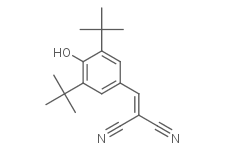
Tyrphostin 9
CAS No. 10537-47-0
Tyrphostin 9( AG 17 | Tyrphostin 9 )
Catalog No. M17782 CAS No. 10537-47-0
Tyrphostin 9 is an Agricultural acaricide, now superseded. Tyrphostin 9 is firstly designed as an EGFR inhibitor
Purity : >98% (HPLC)
 COA
Datasheet
HNMR
HPLC
MSDS
Handing Instructions
COA
Datasheet
HNMR
HPLC
MSDS
Handing Instructions
| Size | Price / USD | Stock | Quantity |
| 1 mL x 10 mM in DMSO | 28 | In Stock |


|
| 25MG | 36 | In Stock |
|
| 50MG | 49 | In Stock |
|
| 100MG | 86 | In Stock |
|
| 200MG | Get Quote | In Stock |
|
| 500MG | 263 | In Stock |
|
| 1G | Get Quote | In Stock |
|
Biological Information
-
Product NameTyrphostin 9
-
NoteResearch use only, not for human use.
-
Brief DescriptionTyrphostin 9 is an Agricultural acaricide, now superseded. Tyrphostin 9 is firstly designed as an EGFR inhibitor
-
DescriptionTyrphostin 9 is an Agricultural acaricide, now superseded. Tyrphostin 9 is firstly designed as an EGFR inhibitor.
-
In Vitro——
-
In Vivo——
-
SynonymsAG 17 | Tyrphostin 9
-
PathwayOthers
-
TargetOther Targets
-
RecptorEGFR| PDGFR
-
Research AreaCancer
-
Indication——
Chemical Information
-
CAS Number10537-47-0
-
Formula Weight282.38
-
Molecular FormulaC18H22N2O
-
Purity>98% (HPLC)
-
SolubilityDMSO : ≥ 100 mg/mL 354.13 mM; H2O : < 0.1 mg/mL
-
SMILESCC(C)(C)c1cc(cc(c1O)C(C)(C)C)C=C(C#N)C#N
-
Chemical Name——
Shipping & Storage Information
-
Storage(-20℃)
-
ShippingWith Ice Pack
-
Stability≥ 2 years
Reference
1. Gazit A, et al. J Med Chem, 1989, 32(10), 2344-2352.
molnova catalog



related products
-
L-4FPG
L-4FPG inhibits the neutral amino acid transporters ASCT1 and ASCT2. It also shows good brain penetration and potently reduces amphetamine-induced hyperlocomotion.
-
(+)-beta-Cedrene
β-cedrene are bioactive sesquiterpenes found in cedar essential oil and exert antiseptic, anti-inflammatory, antispasmodic, tonic, astringent, diuretic, sedative, insecticidal, and antifungal activities.
-
Pennogenin
Pennogenin is a bioactive component which can be isolated from T. govanianum rhizomes. Pennogenin exhibits significant in vitro inhibitory effect on release of ROS.
