


 Cart
Cart
 sales@molnova.com



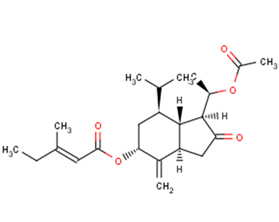
Tussilagone
CAS No. 104012-37-5
Tussilagone( Tussilagone | L-652469 | L652469 | TSL )
Catalog No. M17772 CAS No. 104012-37-5
Tussilagone inhibits dendritic cell function through the induction of heme oxygenase-1.
Purity : >98% (HPLC)
 COA
Datasheet
HNMR
HPLC
MSDS
Handing Instructions
COA
Datasheet
HNMR
HPLC
MSDS
Handing Instructions
| Size | Price / USD | Stock | Quantity |
| 1 mL x 10 mM in DMSO | 92 | In Stock |


|
| 2MG | 67 | In Stock |
|
| 5MG | 106 | In Stock |
|
| 10MG | 170 | In Stock |
|
| 25MG | 306 | In Stock |
|
| 50MG | 449 | In Stock |
|
| 100MG | 677 | In Stock |
|
| 200MG | 913 | In Stock |
|
| 500MG | Get Quote | In Stock |
|
| 1G | Get Quote | In Stock |
|
Biological Information
-
Product NameTussilagone
-
NoteResearch use only, not for human use.
-
Brief DescriptionTussilagone inhibits dendritic cell function through the induction of heme oxygenase-1.
-
DescriptionTussilagone inhibits dendritic cell function through the induction of heme oxygenase-1. Tussilagone has anti-cancer activity, might be a potential chemotherapeutic agent for the prevention and treatment of human colon cancer. Tussilagone has anti-oxidant and anti-inflammatory activities, may be an effective oxygenase-1 inducer and a valuable compound for modulating inflammatory conditions. Tussilagone has potential treatment of neuro-inflammatory diseases through the inhibition of overproduction of nitric oxide and prostaglandin E(2) .
-
In VitroTussilagone suppressed the expression of the inflammatory mediators, nitric oxide and prostaglandin E2, and the inflammatory cytokines, tumor necrosis factor-alpha (TNF-α) and high-mobility group box 1 (HMGB1), in lipopolysaccharide-stimulated RAW 264.7 cells and peritoneal macrophages. Tussilagone also reduced the activation of the mitogen-activated protein kinases and nuclear factor kappa-light-chain-enhancer of activated B cells (NF-κB) involved in the activation of various inflammatory mediators in activated macrophages.
-
In VivoTussilagone administration (1 mg/kg and 10 mg/kg) produced decreased mortality and lung injury in CLP-activated septic mice. Augmented expression of cyclooxygenase (COX)-2 and TNF-α in pulmonary alveolar macrophages of septic mice were attenuated by tussilagone administration.
-
SynonymsTussilagone | L-652469 | L652469 | TSL
-
PathwayMAPK/ERK Signaling
-
TargetERK
-
RecptorOthers
-
Research AreaOthers-Field
-
Indication——
Chemical Information
-
CAS Number104012-37-5
-
Formula Weight390.52
-
Molecular FormulaC23H34O5
-
Purity>98% (HPLC)
-
SolubilityIn Vitro:?DMSO : 62.5 mg/mL (160.05 mM)
-
SMILESCCC(=CC(=O)OC1CC(C2C(C1=C)CC(=O)C2C(C)OC(=O)C)C(C)C)C
-
Chemical Name(1R,3aR,5R,7S,7aS)-1-(1-acetoxyethyl)-7-isopropyl-4-methylene-2-oxooctahydro-1H-inden-5-yl (E)-3-methylpent-2-enoate
Shipping & Storage Information
-
Storage(-20℃)
-
ShippingWith Ice Pack
-
Stability≥ 2 years
Reference
molnova catalog



related products
-
Epinephrine HCl
Epinephrine HCl is a hormone and a neurotransmitter.
-
ERα degrader-2
ERα degrader-2 is a selective and potent estrogen receptor (SERD) degrader with anticancer activity, exhibiting an EC50 value of 0.3 nM for ERα degradation.
-
AZD0364
AZD0364 (AZD-0364) is a potent, selective, orally active ERK1/2 inhibitor for treatment of NSCLC.
