


 Cart
Cart
 sales@molnova.com



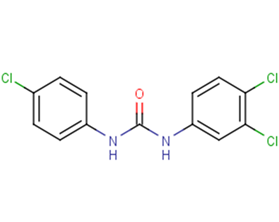
Triclocarban
CAS No. 101-20-2
Triclocarban( 3,4,4′-Trichlorocarbanilide )
Catalog No. M17750 CAS No. 101-20-2
Triclocarban, an antimicrobial agent, is used in personal cleaning products.
Purity : >98% (HPLC)
 COA
Datasheet
HNMR
HPLC
MSDS
Handing Instructions
COA
Datasheet
HNMR
HPLC
MSDS
Handing Instructions
| Size | Price / USD | Stock | Quantity |
| 100MG | Get Quote | In Stock |


|
| 200MG | Get Quote | In Stock |
|
| 500MG | Get Quote | In Stock |
|
| 1G | 29 | In Stock |
|
Biological Information
-
Product NameTriclocarban
-
NoteResearch use only, not for human use.
-
Brief DescriptionTriclocarban, an antimicrobial agent, is used in personal cleaning products.
-
DescriptionTriclocarban, an antimicrobial agent, is used in personal cleaning products.(In Vitro):Triclocarban (300 nM) potentiates the cytotoxicity of 300 μM H2O2 in rat thymocytes. Triclocarban (300 nM) does not increase the population of death cells, it facilitates the process of cell death induced by H2O2, resulting in further increase in the population of dead cells. Triclocarban exertes estrogenic activities by inducing luciferase activities in an ER reporter gene assay, promoting the proliferation of the MCF-7 cells, up-regulating the expression of pS2 and down-regulating ERα expression at both the mRNA and protein levels in the MCF-7 cells.(In Vivo):Triclocarban is absorbed significantly from soap used during showering in human subjects and that its Cmax in their whole blood ranges from 23 nM to 530 nM. Gestational triclocarban exposure does not affect the ability of dams to carry offspring to term but triclocarban exposure during lactation has adverse consequences on the survival of offspring.
-
In VitroTriclocarban (300 nM) potentiates the cytotoxicity of 300 μM H2O2 in rat thymocytes.Triclocarban (300 nM) does not increase the population of death cells, it facilitates the process of cell death induced by H2O2, resulting in further increase in the population of dead cells. Triclocarban exertes estrogenic activities by inducing luciferase activities in an ER reporter gene assay, promoting the proliferation of the MCF-7 cells, up-regulating the expression of pS2 and down-regulating ERα expression at both the mRNA and protein levels in the MCF-7 cells.
-
In VivoTriclocarban is absorbed significantly from soap used during showering in human subjects and that its Cmax in their whole blood ranges from 23 nM to 530 nM. Gestational triclocarban exposure does not affect the ability of dams to carry offspring to term but triclocarban exposure during lactation has adverse consequences on the survival of off spring.
-
Synonyms3,4,4′-Trichlorocarbanilide
-
PathwayEndocrinology/Hormones
-
TargetAndrogen Receptor (AR)
-
RecptorOthers
-
Research Area——
-
Indication——
Chemical Information
-
CAS Number101-20-2
-
Formula Weight315.58
-
Molecular FormulaC13H9Cl3N2O
-
Purity>98% (HPLC)
-
SolubilityDMSO : ≥ 150 mg/mL; 475.32 mM
-
SMILESClc1ccc(NC(=O)Nc2ccc(Cl)c(Cl)c2)cc1
-
Chemical Name——
Shipping & Storage Information
-
Storage(-20℃)
-
ShippingWith Ice Pack
-
Stability≥ 2 years
Reference
1. Kanbara Y, et al. Nanomolar concentration of triclocarban increases the vulnerability of rat thymocytes to oxidative stress. J Toxicol Sci. 2013 Feb;38(1):49-55.
molnova catalog



related products
-
BAY 1024767
BAY 1024767 (BAY1024767) is a higly potent antagonist of androgen receptor (AR) wild-type (IC50=46 nM) and mutant forms located in the AR ligand-binding domain (LBD).
-
Nilutamide
Nilutamide is an antineoplastic hormonal agent primarily used in the treatment of prostate Y. Nilutamide is a pure, nonsteroidal anti-androgen with affinity for androgen receptors (but not for progestogen, estrogen, or glucocorticoid receptors).
-
AZD3514
AZD3514 is a potent and oral androgen receptor downregulator with Ki of 2.2 μM and has ability of reducing AR protein expression.Phase 1.
