


 Cart
Cart
 sales@molnova.com



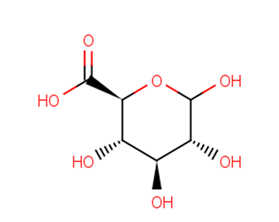
D-Glucuronic acid
CAS No. 6556-12-3
D-Glucuronic acid( —— )
Catalog No. M17733 CAS No. 6556-12-3
Glucuronic Acid is a carboxylic acid with structural similarity to glucose with detoxifying activity.
Purity : >98% (HPLC)
 COA
Datasheet
HNMR
HPLC
MSDS
Handing Instructions
COA
Datasheet
HNMR
HPLC
MSDS
Handing Instructions
| Size | Price / USD | Stock | Quantity |
| 1 mL x 10 mM in DMSO | 28 | In Stock |


|
| 100MG | 38 | In Stock |
|
| 200MG | Get Quote | In Stock |
|
| 500MG | Get Quote | In Stock |
|
| 1G | Get Quote | In Stock |
|
Biological Information
-
Product NameD-Glucuronic acid
-
NoteResearch use only, not for human use.
-
Brief DescriptionGlucuronic Acid is a carboxylic acid with structural similarity to glucose with detoxifying activity.
-
DescriptionGlucuronic Acid is a carboxylic acid with structural similarity to glucose with detoxifying activity. The xenobiotic metabolism of various substances such as drugs, pollutants, bilirubin, androgens, estrogens, mineralocorticoids, glucocorticoids, fatty acid derivatives, retinoids, and bile acids involves glucuronidation, a process in which water-soluble, excretable glucuronides of these substances are formed via glycosidic linkages to glucuronic acid. UDP-glucuronic acid, formed in the liver through the linkage of glucuronic acid to uridine diphosphate (UDP) via a glycosidic bond, is an intermediate in the process of glucuronidation.
-
In Vitro——
-
In Vivo——
-
Synonyms——
-
PathwayEndocrinology/Hormones
-
Target5-HT Receptor
-
RecptorOthers
-
Research Area——
-
Indication——
Chemical Information
-
CAS Number6556-12-3
-
Formula Weight194.13
-
Molecular FormulaC6H10O7
-
Purity>98% (HPLC)
-
SolubilityIn Vitro:?H2O : 100 mg/mL (515.09 mM)
-
SMILESC(=O)C(C(C(C(C(=O)O)O)O)O)O
-
Chemical Name——
Shipping & Storage Information
-
Storage(-20℃)
-
ShippingWith Ice Pack
-
Stability≥ 2 years
Reference
molnova catalog



related products
-
Terfenadine
Terfenadine is a histamine H1-receptor antagonist, which blocks HERG and KATP (KIR6) channels.
-
Prucalopride
Prucalopride is a selective, high affinity 5-HT receptor agonist for 5-HT4A and 5-HT4B receptor with Ki of 2.5 nM and 8 nM, respectively.
-
p-MPPI hydrochloride
p-MPPI hydrochloride is a selective antagonist of 5-HT1A receptor, and has antidepressant and anxiolytic-like effects.
