


 Cart
Cart
 sales@molnova.com



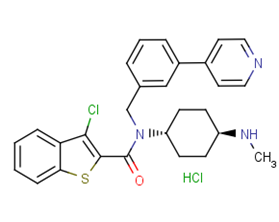
SAG hydrochloride
CAS No. ——
SAG hydrochloride ( —— )
Catalog No. M17700 CAS No. ——
SAG hydrochloride is a chlorobenzothiophene-containing compound which acts as a SMO agonist.
Purity : >98% (HPLC)
 COA
Datasheet
HNMR
HPLC
MSDS
Handing Instructions
COA
Datasheet
HNMR
HPLC
MSDS
Handing Instructions
| Size | Price / USD | Stock | Quantity |
| 5MG | 168 | Get Quote |


|
| 10MG | 302 | Get Quote |
|
| 25MG | 512 | Get Quote |
|
| 100MG | Get Quote | Get Quote |
|
| 200MG | Get Quote | Get Quote |
|
| 500MG | Get Quote | Get Quote |
|
| 1G | Get Quote | Get Quote |
|
Biological Information
-
Product NameSAG hydrochloride
-
NoteResearch use only, not for human use.
-
Brief DescriptionSAG hydrochloride is a chlorobenzothiophene-containing compound which acts as a SMO agonist.
-
DescriptionSAG hydrochloride is a chlorobenzothiophene-containing compound which acts as a SMO agonist.
-
In Vitro——
-
In Vivo——
-
Synonyms——
-
PathwayEndocrinology/Hormones
-
TargetRAAS
-
RecptorHedgehog/Smoothened
-
Research Area——
-
Indication——
Chemical Information
-
CAS Number——
-
Formula Weight526.52
-
Molecular FormulaC28H29Cl2N3OS
-
Purity>98% (HPLC)
-
Solubility——
-
SMILESCNC1CCC(CC1)N(CC2=CC=CC(=C2)C3=CC=NC=C3)C(=O)C4=C(C5=CC=CC=C5S4)Cl.Cl
-
Chemical Name——
Shipping & Storage Information
-
Storage(-20℃)
-
ShippingWith Ice Pack
-
Stability≥ 2 years
Reference
1. Chen JK, et al. Small molecule modulation of Smoothened activity. Proc Natl Acad Sci U S A. 2002 Oct 29;99(22):14071-6.
molnova catalog



related products
-
OPHIOPOGONIN D
Ophiopogonin D is a natural productand is a CYP2J3 inducer that significantly inhibits Ang II induced NF-κB nuclear translocation.
-
FPL-62129
FPL-62129 is a calcium channel antagonist and a novel angiotensin-converting enzyme inhibitor with vasodilator activity for the study of cardiovascular disease.
-
Telmisartan
Telmisartan is an angiotensin II receptor antagonist (ARB) used in the management of hypertension.
