


 Cart
Cart
 sales@molnova.com



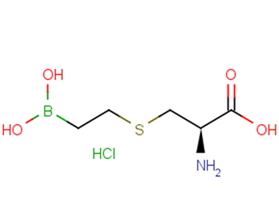
BEC HCl
CAS No. 222638-67-7
BEC HCl( —— )
Catalog No. M17443 CAS No. 222638-67-7
BEC HCl is a competitive arginase inhibitor, which bind slowly. Ki of BEC HCl is 0.31 μM (pH7.5) for Arginase II, and is 0.4-0.6 μM for rat Arginase I.
Purity : >98% (HPLC)
 COA
Datasheet
HNMR
HPLC
MSDS
Handing Instructions
COA
Datasheet
HNMR
HPLC
MSDS
Handing Instructions
| Size | Price / USD | Stock | Quantity |
| 1 mL x 10 mM in DMSO | 77 | In Stock |


|
| 5MG | 77 | In Stock |
|
| 10MG | 147 | In Stock |
|
| 25MG | 282 | In Stock |
|
| 50MG | 454 | In Stock |
|
| 100MG | 649 | In Stock |
|
| 200MG | 899 | In Stock |
|
| 500MG | Get Quote | In Stock |
|
| 1G | Get Quote | In Stock |
|
Biological Information
-
Product NameBEC HCl
-
NoteResearch use only, not for human use.
-
Brief DescriptionBEC HCl is a competitive arginase inhibitor, which bind slowly. Ki of BEC HCl is 0.31 μM (pH7.5) for Arginase II, and is 0.4-0.6 μM for rat Arginase I.
-
DescriptionBEC HCl is a competitive arginase inhibitor, which bind slowly. Ki of BEC HCl is 0.31 μM (pH7.5) for Arginase II, and is 0.4-0.6 μM for rat Arginase I.
-
In VitroThe X-ray crystal structure of the arginase-BEC complex has been determined at 2.3 ? resolution from crystals perfectly twinned by hemihedry. The structure of the complex reveals that the boronic acid moiety undergoes nucleophilic attack by metal-bridging hydroxide ion to yield a tetrahedral boronate anion that bridges the binuclear manganese cluster, thereby mimicking the tetrahedral intermediate (and its flanking transition states) in the arginine hydrolysis reaction.
-
In VivoAdministration of the arginase inhibitor BEC decreases arginase activity and causes alterations in NO homeostasis, which are reflected by increases in S-nitrosylated and nitrated proteins in the lungs from inflamed mice. BEC enhances perivascular and peribronchiolar lung inflammation, mucus metaplasia, NF-κB DNA binding, and mRNA expression of the NF-κB-driven chemokine genes CCL20 and KC, and leads to further increases in airways hyperresponsiveness. Animal Model:C57BL/6J wild-type mice, mice deficient in arginase 2 (Arg2-/-), mice deficient in both arginase 1 and 2 (Arg1-/-Arg2-/-), and mice deficient in NOX2 (NOX2-/-Dosage:20 mg/kg. Administration:I.V., in 0.9% saline, 1 hour before the injection of LPS.Result:BEC robustly reduced VEGF expression in neuroglia (72% reduction) and macrophage/microglia (87% reduction).
-
Synonyms——
-
PathwayGPCR/G Protein
-
TargetAntibacterial
-
RecptorArginase-2| rat Arginase I
-
Research AreaCancer
-
Indication——
Chemical Information
-
CAS Number222638-67-7
-
Formula Weight229.49
-
Molecular FormulaC5H12BNO4S·ClH
-
Purity>98% (HPLC)
-
SolubilityH2O : ≥ 35 mg/mL; 152.51 mM
-
SMILESC(=O)([C@H](CSCCB(O)O)N)O.Cl
-
Chemical Name——
Shipping & Storage Information
-
Storage(-20℃)
-
ShippingWith Ice Pack
-
Stability≥ 2 years
Reference
1.Colleluori DM et al. Classical and slow-binding inhibitors of human type II arginase. Biochemistry. 2001 Aug 7;40(31):9356-62.
molnova catalog



related products
-
Bisdionin C
Bisdionin C is a potent inhibitor of GH18 chitinase with an IC50 of 0.2 μM for A. fumigatus ChiB1. Bisdionin C inhibits human macrophage chitotriosidase(HCHT, IC50 = 8.3 μM) and acidic mammalian chitinase (AMCase, IC50 = 3.4 μM).
-
(-)-TERPINEN-4-OL
Terpinen-4-ol can be used as an antibacterial and antibiofilm agent against Staphylococcus aureus.
-
Phellodendrine chlor...
Phellodendrine chloride has anti-nephritic activity, may be due to its ability to inhibit the proliferation or the migration of macrophages and cytotoxic T lymphocytes in the glomeruli.
