


 Cart
Cart
 sales@molnova.com



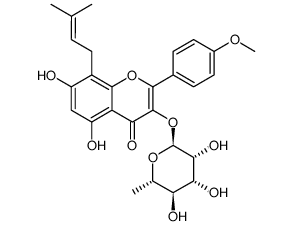
Baohuoside I
CAS No. 113558-15-9
Baohuoside I( Icariin-II | Icariside-II )
Catalog No. M17154 CAS No. 113558-15-9
Baohuoside I is a component of Epimedium koreanum, exhibits anti-inflammatory activity and anti-osteoporosis activities.
Purity : >98% (HPLC)
 COA
Datasheet
HNMR
HPLC
MSDS
Handing Instructions
COA
Datasheet
HNMR
HPLC
MSDS
Handing Instructions
| Size | Price / USD | Stock | Quantity |
| 1 mL x 10 mM in DMSO | 125 | In Stock |


|
| 2MG | 36 | In Stock |
|
| 5MG | 57 | In Stock |
|
| 10MG | 93 | In Stock |
|
| 25MG | 180 | In Stock |
|
| 50MG | 276 | In Stock |
|
| 100MG | 461 | In Stock |
|
| 200MG | 644 | In Stock |
|
| 500MG | Get Quote | In Stock |
|
| 1G | Get Quote | In Stock |
|
Biological Information
-
Product NameBaohuoside I
-
NoteResearch use only, not for human use.
-
Brief DescriptionBaohuoside I is a component of Epimedium koreanum, exhibits anti-inflammatory activity and anti-osteoporosis activities.
-
DescriptionBaohuoside I is a component of Epimedium koreanum, exhibits anti-inflammatory activity and anti-osteoporosis activities.
-
In VitroBaohuoside I is an inhibitor of CXCR4, and downregulates CXCR4 expression at 12-25 μM. Baohuoside I (0-25 μM) suppresses NF-κB activation in a dose-dependent manner, suppresses CXCL12 induced the invasion of cervical cancer cells. Baohuoside I also inhibits invasion of breast cancer cells. Baohuoside I inhibits A549 cell viability, with IC50s of 25.1 μM at 24 h, 11.5 μM and 9.6 μM at 48 h and 72 h, respectively. Baohuoside I ((25 μM) suppresses the caspase cascade in A549 cells, elevates ROS levels and activates JNK and p38MAPK signaling cascade. Baohuoside I (3.125, 6.25, 12.5, 25.0 and 50.0 μg/mL) significantly and dose-dependently blocks the growth of esophageal squamous cell carcinoma Eca109 cells, with an IC50 of 4.8 μg/mL at 48 h.
-
In VivoBaohuoside I (25 mg/kg) decreases β-catenin protein levels, cyclin D1 and survivin expression in nude mice.
-
SynonymsIcariin-II | Icariside-II
-
PathwayOthers
-
TargetOther Targets
-
RecptorCXCR4
-
Research AreaOthers-Field
-
Indication——
Chemical Information
-
CAS Number113558-15-9
-
Formula Weight514.52
-
Molecular FormulaC27H30O10
-
Purity>98% (HPLC)
-
SolubilityDMSO : ≥ 32 mg/mL 62.19 mM
-
SMILESC[C@H]1[C@H](O)[C@H]([C@H]([C@@H](O1)Oc1c(oc2c(c1=O)c(cc(c2CC=C(C)C)O)O)c1ccc(cc1)OC)O)O
-
Chemical Name——
Shipping & Storage Information
-
Storage(-20℃)
-
ShippingWith Ice Pack
-
Stability≥ 2 years
Reference
1. Kim B, et al. Biochemistry. 2014 Dec 9;53(48):7562-9.
molnova catalog



related products
-
Angiotensin I/II (3-...
Angiotensin I/II (3-8)
-
EC5026
EC5026 has the potential to relieve pain by stabilizing natural analgesic and anti-inflammatory mediators.?EC5026 (BPN-19186) is a first-in-class, small molecule that potently inhibits soluble Epoxide Hydrolase (sEH), a key regulatory enzyme involved in the metabolism of membrane fatty acids.?Inhibition of sEH treats pain by stabilizing natural analgesic and anti-inflammatory mediators.
-
Acetyl-Amylin (8-37)...
Acetyl-Amylin (8-37) (mouse, rat)
