


 Cart
Cart
 sales@molnova.com



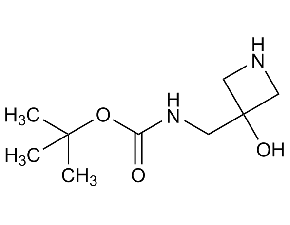
tert-Butyl ((3-hydroxyazetidin-3-yl)methyl)carbamate
CAS No. 1035351-07-5
tert-Butyl ((3-hydroxyazetidin-3-yl)methyl)carbamate( —— )
Catalog No. M17122 CAS No. 1035351-07-5
tert-Butyl ((3-hydroxyazetidin-3-yl)methyl)carbamate is an active biochemical agent.
Purity : >98% (HPLC)
 COA
Datasheet
HNMR
HPLC
MSDS
Handing Instructions
COA
Datasheet
HNMR
HPLC
MSDS
Handing Instructions
| Size | Price / USD | Stock | Quantity |
| 1 mL x 10 mM in DMSO | 39 | In Stock |


|
| 5MG | 39 | In Stock |
|
| 10MG | 65 | In Stock |
|
| 25MG | 115 | In Stock |
|
| 50MG | 184 | In Stock |
|
| 100MG | 269 | In Stock |
|
| 200MG | 383 | In Stock |
|
| 500MG | Get Quote | In Stock |
|
| 1G | Get Quote | In Stock |
|
Biological Information
-
Product Nametert-Butyl ((3-hydroxyazetidin-3-yl)methyl)carbamate
-
NoteResearch use only, not for human use.
-
Brief Descriptiontert-Butyl ((3-hydroxyazetidin-3-yl)methyl)carbamate is an active biochemical agent.
-
Descriptiontert-Butyl ((3-hydroxyazetidin-3-yl)methyl)carbamate is an active biochemical agent.
-
In Vitro——
-
In Vivo——
-
Synonyms——
-
PathwayOthers
-
TargetOther Targets
-
RecptorOthers
-
Research Area——
-
Indication——
Chemical Information
-
CAS Number1035351-07-5
-
Formula Weight202.25
-
Molecular FormulaC9H18N2O3
-
Purity>98% (HPLC)
-
Solubility——
-
SMILESC1NCC1(CNC(=O)OC(C)(C)C)O
-
Chemical Name——
Shipping & Storage Information
-
Storage(-20℃)
-
ShippingWith Ice Pack
-
Stability≥ 2 years
Reference
molnova catalog



related products
-
WWL229
WWL229 is a selective inhibitor of Ces3.
-
Plathymenin
Plathymenin is a natural product isolated from Spatholobus suberectus.
-
DL-Arabinose
D-Arabinose also known as (+/-)-arabinose or aloe sugar belongs to the class of organic compounds known as pentoses. D-Arabinose has been primarily detected in feces.
