


 Cart
Cart
 sales@molnova.com



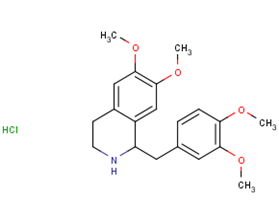
Tetrahydropapaverine hydrochloride
CAS No. 6429-04-5
Tetrahydropapaverine hydrochloride( —— )
Catalog No. M17110 CAS No. 6429-04-5
Tetrahydropapaverine, an analogue of salsolinol and tetrahydropapaveroline, has neurotoxicity on dopamine neurons.
Purity : >98% (HPLC)
 COA
Datasheet
HNMR
HPLC
MSDS
Handing Instructions
COA
Datasheet
HNMR
HPLC
MSDS
Handing Instructions
| Size | Price / USD | Stock | Quantity |
| 1 mL x 10 mM in DMSO | 28 | In Stock |


|
| 5MG | 58 | In Stock |
|
| 10MG | 72 | In Stock |
|
| 50MG | 95 | In Stock |
|
| 100MG | 140 | In Stock |
|
| 200MG | 205 | In Stock |
|
| 500MG | 350 | In Stock |
|
| 1G | Get Quote | In Stock |
|
Biological Information
-
Product NameTetrahydropapaverine hydrochloride
-
NoteResearch use only, not for human use.
-
Brief DescriptionTetrahydropapaverine, an analogue of salsolinol and tetrahydropapaveroline, has neurotoxicity on dopamine neurons.
-
DescriptionTetrahydropapaverine, an analogue of salsolinol and tetrahydropapaveroline, has neurotoxicity on dopamine neurons.
-
In Vitro——
-
In Vivo——
-
Synonyms——
-
PathwayOthers
-
TargetOther Targets
-
RecptorTryptophan hydroxylase
-
Research AreaNeurological Disease
-
Indication——
Chemical Information
-
CAS Number6429-04-5
-
Formula Weight379.88
-
Molecular FormulaC20H25NO4·HCl
-
Purity>98% (HPLC)
-
SolubilityIn Vitro:?H2O : ≥ 100 mg/mL (263.24 mM))
-
SMILESCOc1c(cc(cc1)CC1c2cc(c(cc2CCN1)OC)OC)OC.Cl
-
Chemical Name——
Shipping & Storage Information
-
Storage(-20℃)
-
ShippingWith Ice Pack
-
Stability≥ 2 years
Reference
1. Kim EI, et al. Life Sci, 2004, 75(16), 1949-1957.
molnova catalog



related products
-
Cimicifugic acid F
Cimicifugic acid F has antioxidant activity. Cimicifugic acid F shows inhibition of neutrophil elastase activity with an IC50 of 18 mumol/L.
-
SGK1-IN-4
SGK1-IN-4 is a selective inhibitor of SGK1 and can be used in studies about osteoarthritis.
-
Cassythine
Cassyfiline (Cassythine) is an aporphine alkaloid. Cassyfiline has potent vasorelaxing effects on precontracted rat aortic preparations with an IC50 of 0.09 μM.
