


 Cart
Cart
 sales@molnova.com



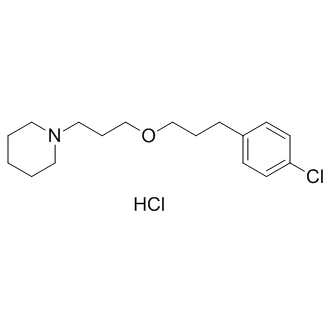
Pitolisant hydrochloride
CAS No. 903576-44-3
Pitolisant hydrochloride( Ciproxidine | BF 2649 | BF2649 | BF-2649 )
Catalog No. M16495 CAS No. 903576-44-3
A potent and selective antagonist of H3 receptor with Ki/EC50 of 0.16/1.5 nM.
Purity : >98% (HPLC)
 COA
Datasheet
HNMR
HPLC
MSDS
Handing Instructions
COA
Datasheet
HNMR
HPLC
MSDS
Handing Instructions
| Size | Price / USD | Stock | Quantity |
| 1 mL x 10 mM in DMSO | 46 | In Stock |


|
| 5MG | 41 | In Stock |
|
| 10MG | 65 | In Stock |
|
| 25MG | 120 | In Stock |
|
| 50MG | 193 | In Stock |
|
| 100MG | 305 | In Stock |
|
| 200MG | 458 | In Stock |
|
| 500MG | 732 | In Stock |
|
| 1G | Get Quote | In Stock |
|
Biological Information
-
Product NamePitolisant hydrochloride
-
NoteResearch use only, not for human use.
-
Brief DescriptionA potent and selective antagonist of H3 receptor with Ki/EC50 of 0.16/1.5 nM.
-
DescriptionA potent and selective antagonist of H3 receptor with Ki/EC50 of 0.16/1.5 nM; no effect on H1, H2, H4 receptors (IC50>10 uM); orally bioactive.Sleep Disorder Approved(In Vitro):On the stimulation of guanosine 5′-O-(3-[35S]thio)triphosphate binding to this receptor, Pitolisant (BF2.649) behaves as a competitive antagonist with a Ki value of 0.16 nM and as an inverse agonist with an EC50 value of 1.5 nM and an intrinsic activity ~50% higher than that of ciproxifan. Pitolisant displaces [125I]iodoproxyfan binding from mouse brain cortical membranes with an IC50 value of 26.4±4.5 nM. Taking into account the Kd value of the radioligand (161±9 pM), the deduced Ki value for Pitolisant is 14±1 nM. Pitolisant displaces [125I]iodoproxyfan binding from membranes of rat glioma C6 cells stably expressing the human H3 receptor with an IC50 value of 4.2±0.2 nM. Taking into account the Kd value of the radioligand (50±4 pM), the deduced Ki value for Pitolisant is 2.7±0.5 nM. Pitolisant progressively reverses this response with a Hill coefficient close to unity and an IC50 value of 330±68 nM, leading to a Ki value of 17±4 nM. Pitolisant elicits a dose-dependent decrease of the basal-specific [35S]GTPγS binding to membranes with a maximal effect corresponding to 75±1% of the basal-specific binding and an EC50 value of 1.5±0.1 nM. (In Vivo):The administration of Pitolisantat a single dose of 10 mg/kg 30 min before a single dose of LY170053 (2 mg/kg b.w.) also significantly affects immobility time in the FST. Subsequent administration of the aforementioned drug sequence in mice statistically significantly increases the duration of immobility in comparison to the time determined in the control group in the FST. It decreased locomotor activity as well. In contrast, the results obtained in subchronic treatment after fifteen administrations of both drugs (Pitolisant 10 mg/kg b.w., and after 30 min LY170053 2 mg/kg b.w., and again after 4 h LY170053 2 mg/kg b.w.) show that the administration of Pitolisant followed by that of LY170053 equalized the locomotor activity in mice; in comparison to the level of motility in the control group, to which only Pitolisant is administered. More importantly, this combination of drugs significantly reduces immobility time to the level obtained in the control group in the forced swim test in mice [one-way ANOVA; F(3,20)=4.226,P=0.0181]. Rats given Pitolisant (10 mg/kg) during the conditioning phase stayed 502±94 s on the paired texture, a value not statistically different from that of controls, indicating that Pitolisant did not support place preference.
-
In VitroOn the stimulation of guanosine 5′-O-(3-[35S]thio)triphosphate binding to this receptor, Pitolisant (BF2.649) behaves as a competitive antagonist with a Ki value of 0.16 nM and as an inverse agonist with an EC50 value of 1.5 nM and an intrinsic activity ~50% higher than that of ciproxifan. Pitolisant displaces [125I]iodoproxyfan binding from mouse brain cortical membranes with an IC50 value of 26.4±4.5 nM. Taking into account the Kd value of the radioligand (161±9 pM), the deduced Ki value for Pitolisant is 14±1 nM. Pitolisant displaces [125I]iodoproxyfan binding from membranes of rat glioma C6 cells stably expressing the human H3 receptor with an IC50 value of 4.2±0.2 nM. Taking into account the Kd value of the radioligand (50±4 pM), the deduced Ki value for Pitolisant is 2.7±0.5 nM. Pitolisant progressively reverses this response with a Hill coefficient close to unity and an IC50 value of 330±68 nM, leading to a Ki value of 17±4 nM. Pitolisant elicits a dose-dependent decrease of the basal-specific [35S]GTPγS binding to membranes with a maximal effect corresponding to 75±1% of the basal-specific binding and an EC50 value of 1.5±0.1 nM.
-
In VivoThe administration of Pitolisantat a single dose of 10 mg/kg 30 min before a single dose of LY170053 (2 mg/kg b.w.) also significantly affects immobility time in the FST. Subsequent administration of the aforementioned drug sequence in mice statistically significantly increases the duration of immobility in comparison to the time determined in the control group in the FST. It decreased locomotor activity as well. In contrast, the results obtained in subchronic treatment after fifteen administrations of both drugs (Pitolisant 10 mg/kg b.w., and after 30 min LY170053 2 mg/kg b.w., and again after 4 h LY170053 2 mg/kg b.w.) show that the administration of Pitolisant followed by that of LY170053 equalized the locomotor activity in mice; in comparison to the level of motility in the control group, to which only Pitolisant is administered. More importantly, this combination of drugs significantly reduces immobility time to the level obtained in the control group in the forced swim test in mice [one-way ANOVA; F (3,20)=4.226,P=0.0181]. Rats given Pitolisant (10 mg/kg) during the conditioning phase stayed 502±94 s on the paired texture, a value not statistically different from that of controls, indicating that Pitolisant did not support place preference.
-
SynonymsCiproxidine | BF 2649 | BF2649 | BF-2649
-
PathwayGPCR/G Protein
-
TargetHistamine Receptor
-
RecptorHistamine Receptor
-
Research AreaNeurological Disease
-
IndicationSleep Disorder
Chemical Information
-
CAS Number903576-44-3
-
Formula Weight332.3084
-
Molecular FormulaC17H27Cl2NO
-
Purity>98% (HPLC)
-
SolubilityDMSO: ≥ 43 mg/mL
-
SMILESC1CCN(CC1)CCCOCCCC2=CC=C(C=C2)Cl.Cl
-
Chemical NamePiperidine, 1-[3-[3-(4-chlorophenyl)propoxy]propyl]-, hydrochloride (1:1)
Shipping & Storage Information
-
Storage(-20℃)
-
ShippingWith Ice Pack
-
Stability≥ 2 years
Reference
1. Ligneau X, et al. J Pharmacol Exp Ther. 2007 Jan;320(1):365-75.
2. Dudek M, et al. Metab Brain Dis. 2016 Oct;31(5):1023-9.
3. Ligneau X, et al. Biochem Pharmacol. 2007 Apr 15;73(8):1215-24.
molnova catalog



related products
-
Pitolisant oxalate
A potent and selective antagonist of H3 receptor with Ki/EC50 of 0.16/1.5 nM; no effect on H1, H2, H4 receptors (IC50>10 uM).
-
GSK189254A
GSK189254A is a potent and specific histamine H3 receptor antagonist (pKi values: 9.59-9.90 and 8.51-9.17 for human and rat H3).
-
Z-IETD-FMK
Z-IETD-FMK is a selective caspase 8 inhibitor, which has cell permeable.
