


 Cart
Cart
 sales@molnova.com



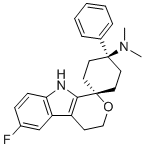
Cebranopadol
CAS No. 863513-91-1
Cebranopadol( GRT-6005 | GRT 6005 | GRT6005 )
Catalog No. M16252 CAS No. 863513-91-1
Cebranopadol (GRT-6005, GRT6005) is a potent analgesic nociceptin/orphanin FQ peptide (NOP) and opioid receptor agonist with Ki/EC50 of 0.9/13 nM (human NOP receptor), 0.7/1.2 nM (mu-opioid receptor).
Purity : >98% (HPLC)
 COA
Datasheet
HNMR
HPLC
MSDS
Handing Instructions
COA
Datasheet
HNMR
HPLC
MSDS
Handing Instructions
| Size | Price / USD | Stock | Quantity |
| 2MG | 31 | In Stock |


|
| 5MG | 50 | In Stock |
|
| 10MG | 80 | In Stock |
|
| 25MG | 160 | In Stock |
|
| 50MG | 260 | In Stock |
|
| 100MG | 385 | In Stock |
|
| 200MG | 561 | In Stock |
|
| 500MG | Get Quote | In Stock |
|
| 1G | Get Quote | In Stock |
|
Biological Information
-
Product NameCebranopadol
-
NoteResearch use only, not for human use.
-
Brief DescriptionCebranopadol (GRT-6005, GRT6005) is a potent analgesic nociceptin/orphanin FQ peptide (NOP) and opioid receptor agonist with Ki/EC50 of 0.9/13 nM (human NOP receptor), 0.7/1.2 nM (mu-opioid receptor).
-
DescriptionCebranopadol (GRT-6005, GRT6005) is a potent analgesic nociceptin/orphanin FQ peptide (NOP) and opioid receptor agonist with Ki/EC50 of 0.9/13 nM (human NOP receptor), 0.7/1.2 nM (mu-opioid receptor); exhibits highly potent and efficacious antinociceptive and antihypersensitive effects in several rat models of acute and chronic pain with ED50 values of 0.5-5.6 μg/kg after oral administration, does not disrupt motor coordination and respiration.Pain Phase 3 Clinical(In Vitro):Cebranopadol binds with high affinity (subnanomolar to nanomolar range) to nociceptin/orphanin FQ peptide (NOP) and opioid receptors, with Ki of 1±0.5 nM, 2.4±1.2 nM, and 64±11 nM for rat NOP, mu-opioid peptide (MOP) receptor, and kappa-opioid peptide (KOP) receptor, and with Ki of 0.9±0.2 nM, 0.7±0.3 nM, and 2.6±1.4 nM for Rat NOP, MOP, and KOP receptor.(In Vivo):Cebranopadol exhibits highly potent and efficacious antinociceptive and antihypersensitive effects in several rat models of acute and chronic pain (tail-flick, rheumatoid arthritis, bone cancer, spinal nerve ligation, diabetic neuropathy) with ED50 values of 0.5-5.6 μg/kg after intravenous and 25.1 μg/kg after oral administration. In comparison with selective MOP receptor agonists, cebranopadol is more potent in models of chronic neuropathic than acute nociceptive pain. Cebranopadol’s duration of action is long (up to 7 hours after intravenous 12 μg/kg; >9 hours after oral 55 μg/kg in the rat tail-flick test). The antihypersensitive activity of cebranopadol in the spinal nerve ligation model is partially reversed by pretreatment with the selective NOP receptor antagonist J-113397 or the opioid receptor antagonist naloxone, indicating that both NOP and opioid receptor agonism are involved in this activity.
-
In VitroCebranopadol binds with high affinity (subnanomolar to nanomolar range) to nociceptin/orphanin FQ peptide (NOP) and opioid receptors, with Ki of 1±0.5 nM, 2.4±1.2 nM, and 64±11 nM for rat NOP, mu-opioid peptide (MOP) receptor, and kappa-opioid peptide (KOP) receptor, and with Ki of 0.9±0.2 nM, 0.7±0.3 nM, and 2.6±1.4 nM for Rat NOP, MOP, and KOP receptor.
-
In VivoCebranopadol exhibits highly potent and efficacious antinociceptive and antihypersensitive effects in several rat models of acute and chronic pain (tail-flick, rheumatoid arthritis, bone cancer, spinal nerve ligation, diabetic neuropathy) with ED50 values of 0.5-5.6 μg/kg after intravenous and 25.1 μg/kg after oral administration. In comparison with selective MOP receptor agonists, cebranopadol is more potent in models of chronic neuropathic than acute nociceptive pain. Cebranopadol’s duration of action is long (up to 7 hours after intravenous 12 μg/kg; >9 hours after oral 55 μg/kg in the rat tail-flick test). The antihypersensitive activity of cebranopadol in the spinal nerve ligation model is partially reversed by pretreatment with the selective NOP receptor antagonist J-113397 or the opioid receptor antagonist naloxone, indicating that both NOP and opioid receptor agonism are involved in this activity.
-
SynonymsGRT-6005 | GRT 6005 | GRT6005
-
PathwayEndocrinology/Hormones
-
TargetOpioid Receptor
-
RecptorNOP|μ-opioidreceptor|κ-opioidreceptor|δ-opioidreceptor
-
Research AreaNeurological Disease
-
IndicationPain
Chemical Information
-
CAS Number863513-91-1
-
Formula Weight378.491
-
Molecular FormulaC24H27FN2O
-
Purity>98% (HPLC)
-
SolubilityDMSO: 6 mg/mL; Water: Insoluble ( < 1 mg/ml refers to the product slightly soluble or insoluble )
-
SMILESCN(C)C1(CCC2(CC1)C3=C(CCO2)C4=C(N3)C=CC(=C4)F)C5=CC=CC=C5
-
Chemical Name(1r,4r)-6'-fluoro-N,N-dimethyl-4-phenyl-4',9'-dihydro-3'H-spiro[cyclohexane-1,1'-pyrano[3,4-b]indol]-4-amine
Shipping & Storage Information
-
Storage(-20℃)
-
ShippingWith Ice Pack
-
Stability≥ 2 years
Reference
1. Linz K, et al. J Pharmacol Exp Ther. 2014 Jun;349(3):535-48.
2. Schunk S, et al. ACS Med Chem Lett. 2014 Jun 24;5(8):857-62.
molnova catalog



related products
-
Gluten Exorphin C
Gluten exorphin C is an opioid peptide derived from wheat gluten. Its IC50 values are 40 μM and 13.5 μM for μ opioid and δ opioid activities in the GPI and MVD assays, respectively.Gluten Exorphin C, isolated from the pepsin-trypsin-chymotrypsin digest of wheat gluten, was considered as a δ-opioid receptor-selective ligand.Gluten exorphin C, a novel opioid peptide, is isolated from the pepsin-trypsin-chymotrypsin digest of wheat gluten.
-
β-Casomorphin, human
β-Casomorphin is an opioid peptide. It was first isolated from an enzymatic digestion of casein that is an agonist at μ opioid receptors.
-
Spiradoline mesylate
Spiradoline (U 62066) is a potent, highly selective κ-opioid agonist that has analgesic diuretic and antitussive effects.
