


 Cart
Cart
 sales@molnova.com



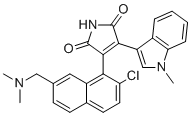
PKC-IN-7
CAS No. 860468-10-6
PKC-IN-7( —— )
Catalog No. M16235 CAS No. 860468-10-6
PKC-IN-7 is a potent, selective, reversible, ATP-competitive PKCα/β inhibitor with IC50 of 4.7/3.3 nM.
Purity : >98% (HPLC)
 COA
Datasheet
HNMR
HPLC
MSDS
Handing Instructions
COA
Datasheet
HNMR
HPLC
MSDS
Handing Instructions
| Size | Price / USD | Stock | Quantity |
| 100MG | Get Quote | Get Quote |


|
| 200MG | Get Quote | Get Quote |
|
| 500MG | Get Quote | Get Quote |
|
| 1G | Get Quote | Get Quote |
|
Biological Information
-
Product NamePKC-IN-7
-
NoteResearch use only, not for human use.
-
Brief DescriptionPKC-IN-7 is a potent, selective, reversible, ATP-competitive PKCα/β inhibitor with IC50 of 4.7/3.3 nM.
-
DescriptionPKC-IN-7 is a potent, selective, reversible, ATP-competitive PKCα/β inhibitor with IC50 of 4.7/3.3 nM; dispalys >50-fold selectivity against PKC isotypes δ,ε,η,θ and other kinases belonging to the AGC family; inhibits IgM-stimulated mouse B cell proliferation with an IC50 of 296 nM.
-
In Vitro——
-
In Vivo——
-
Synonyms——
-
PathwayAngiogenesis
-
TargetPKC
-
RecptorPKC
-
Research Area——
-
Indication——
Chemical Information
-
CAS Number860468-10-6
-
Formula Weight443.931
-
Molecular FormulaC26H22ClN3O2
-
Purity>98% (HPLC)
-
Solubility——
-
SMILES——
-
Chemical Name3-(2-chloro-7-((dimethylamino)methyl)naphthalen-1-yl)-4-(1-methyl-1H-indol-3-yl)-1H-pyrrole-2,5-dione
Shipping & Storage Information
-
Storage(-20℃)
-
ShippingWith Ice Pack
-
Stability≥ 2 years
Reference
1. van Eis MJ, et al. Bioorg Med Chem Lett. 2017 Feb 15;27(4):781-786.
molnova catalog



related products
-
(±)-1,2-Diolein
(±)-1,2-Diolein (1,2-Dioleoyl-rac-glycerol) is a PKC activator. (±)-1,2-Diolein increases myotubes Ca 2+ influx .
-
HG-9-91-01
HG-9-91-01 is a potent and highly selective salt-inducible kinase (SIKs) inhibitor with?IC50s of 0.92 nM, 6.6 nM and 9.6 nM for?SIK1, ?SIK2?and?SIK3respectively.
-
TV 3279
TV 3279 is a novel ChE-MAI inhibitor , and the neuroprotective properties depend on their ability to induce the anti-apoptotic proteins PKC, Bcl-2, Bcl-x, and SOD, and to block the nuclear translocation of the pro-apoptotic enzyme glyceraldehyde phosphate dehydrogenase in PC-12 and neuroblastoma cells.
