


 Cart
Cart
 sales@molnova.com



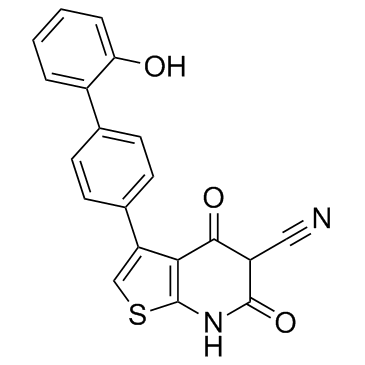
A-769662
CAS No. 844499-71-4
A-769662( A769662 | A 769662 )
Catalog No. M16136 CAS No. 844499-71-4
A small molecule AMPK activator that directly stimulates partially purified rat liver AMPK (EC50=0.8 uM) and inhibits fatty acid synthesis in primary rat hepatocytes (IC50=3.2 uM).
Purity : >98% (HPLC)
 COA
Datasheet
HNMR
HPLC
MSDS
Handing Instructions
COA
Datasheet
HNMR
HPLC
MSDS
Handing Instructions
| Size | Price / USD | Stock | Quantity |
| 1 mL x 10 mM in DMSO | 51 | In Stock |


|
| 2MG | 31 | In Stock |
|
| 5MG | 49 | In Stock |
|
| 10MG | 68 | In Stock |
|
| 25MG | 138 | In Stock |
|
| 50MG | 251 | In Stock |
|
| 100MG | 455 | In Stock |
|
| 200MG | Get Quote | In Stock |
|
| 500MG | 995 | In Stock |
|
| 1G | Get Quote | In Stock |
|
Biological Information
-
Product NameA-769662
-
NoteResearch use only, not for human use.
-
Brief DescriptionA small molecule AMPK activator that directly stimulates partially purified rat liver AMPK (EC50=0.8 uM) and inhibits fatty acid synthesis in primary rat hepatocytes (IC50=3.2 uM).
-
DescriptionA small molecule AMPK activator that directly stimulates partially purified rat liver AMPK (EC50=0.8 uM) and inhibits fatty acid synthesis in primary rat hepatocytes (IC50=3.2 uM); decreases hepatic expression of PEPCK, G6Pase, and FAS, lowered plasma glucose by 40%, reduces body weight gain and significantly decreases both plasma and liver triglyceride levels in ob/ob mice (30 mg/kg b.i.d.); also directly inhibits Na(+)-K(+)-ATPase, decreases the sodium pump cell surface abundance in L6 skeletal muscle cells.Diabetes Preclinical(In Vitro):A-769662 is equally potent in activating the baculovirus expressed α1,β1,γ1 recombinant isoform of AMPK (EC50=0.7 μM). A-769662 and A-592107 activate AMPK purified from multiple tissues and species in a dose-responsive manner with modest variations in observed EC50s. EC50s determined for A-769662 using partially purified AMPK extracts from rat heart, rat muscle, or human embryonic kidney cells (HEKs) are 2.2 μM, 1.9 μM, or 1.1 μM, respectively. A-769662 activates endogenous AMPK in LKB1-expressing (HEK293) and LKB1-deficient (CCL13) cells. A-769662 allosterically activates AMPK complexes containing γ1 harboring a substitution of arginine residue 298 to glycine (R298G). A-769662 inhibits dephosphorylation of Thr-172 in the mutant γ1-containing complexes to a similar degree as seen in the wild-type complexes. A769662 (300 μM) has toxic effects on MEF cells. A769662 reversibly inhibits the proteasomal activity.(In Vivo):A-769662 (30 mg/kg, i.p.) significantly reduced the respiratory exchange ratio (RER) in the SD rat. There are 33% and 58% reductions of malonyl CoA levels in livers of animals treated with 30 mg/kg A-769662 (0.905 nmol/g) or 500 mg/kg metformin (0.574 nmol/g), respectively. A-769662 (30 mg/kg, b.i.d.) significantly decreases fed plasma glucose (30%-40% reduction), while the lower doses (3 and 10 mg/kg) of A-769662 had no effect on the in diabetic ob/ob mice.
-
In VitroA-769662 is equally potent in activating the baculovirus expressed α1,β1,γ1 recombinant isoform of AMPK (EC50=0.7 μM). A-769662 and A-592107 activate AMPK purified from multiple tissues and species in a dose-responsive manner with modest variations in observed EC50s. EC50s determined for A-769662 using partially purified AMPK extracts from rat heart, rat muscle, or human embryonic kidney cells (HEKs) are 2.2 μM, 1.9 μM, or 1.1 μM, respectively. A-769662 activates endogenous AMPK in LKB1-expressing (HEK293) and LKB1-deficient (CCL13) cells. A-769662 allosterically activates AMPK complexes containing γ1 harboring a substitution of arginine residue 298 to glycine (R298G). A-769662 inhibits dephosphorylation of Thr-172 in the mutant γ1-containing complexes to a similar degree as seen in the wild-type complexes. A769662 (300 μM) has toxic effects on MEF cells. A769662 reversibly inhibits the proteasomal activity.
-
In VivoA-769662 (30 mg/kg, i.p.) significantly reduced the respiratory exchange ratio (RER) in the SD rat. There are 33% and 58% reductions of malonyl CoA levels in livers of animals treated with 30 mg/kg A-769662 (0.905 nmol/g) or 500 mg/kg metformin (0.574 nmol/g), respectively. A-769662 (30 mg/kg, b.i.d.) significantly decreases fed plasma glucose (30%-40% reduction), while the lower doses (3 and 10 mg/kg) of A-769662 had no effect on the in diabetic ob/ob mice.
-
SynonymsA769662 | A 769662
-
PathwayMembrane Transporter/Ion Channel
-
TargetAMPK
-
RecptorAMPK|FAS
-
Research AreaMetabolic Disease
-
IndicationDiabetes
Chemical Information
-
CAS Number844499-71-4
-
Formula Weight360.3859
-
Molecular FormulaC20H12N2O3S
-
Purity>98% (HPLC)
-
SolubilityDMSO: 24 mg/mL
-
SMILESN#CC1=C(O)C(C(C2=CC=C(C3=CC=CC=C3O)C=C2)=CS4)=C4NC1=O
-
Chemical NameThieno[2,3-b]pyridine-5-carbonitrile, 6,7-dihydro-4-hydroxy-3-(2'-hydroxy[1,1'-biphenyl]-4-yl)-6-oxo-
Shipping & Storage Information
-
Storage(-20℃)
-
ShippingWith Ice Pack
-
Stability≥ 2 years
Reference
1. Cool B, et al. Cell Metab. 2006 Jun;3(6):403-16.
2. G?ransson O, et al. J Biol Chem. 2007 Nov 9;282(45):32549-60.
3. Benziane B, et al. Am J Physiol Cell Physiol. 2009 Dec;297(6):C1554-66.
molnova catalog



related products
-
WZ4003
WZ4003 is a highly specific NUAK kinase inhibitor with IC50 of 20 nM and 100 nM for NUAK1 and NUAK2, respectively.
-
SAMS
SAMS peptide is a specific substrate for the AMP-activated protein kinase (AMPK).
-
MSX-122
MSX-122 is a novel small molecule and partial CXCR4 antagonist, with potent inhibition of CXCR4/CXCL12 actions(IC50 = 10 nM).
