


 Cart
Cart
 sales@molnova.com



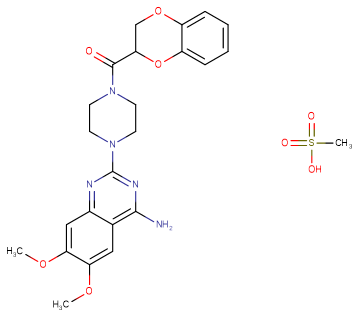
Doxazosin mesylate
CAS No. 77883-43-3
Doxazosin mesylate( UK 33274-27 )
Catalog No. M15940 CAS No. 77883-43-3
Doxazosin mesylate(UK 33274) is a quinazoline-derivative that selectively antagonizes postsynaptic α1-adrenergic receptors.
Purity : >98% (HPLC)
 COA
Datasheet
HNMR
HPLC
MSDS
Handing Instructions
COA
Datasheet
HNMR
HPLC
MSDS
Handing Instructions
| Size | Price / USD | Stock | Quantity |
| 200MG | 34 | In Stock |


|
| 500MG | 58 | In Stock |
|
| 1G | 74 | In Stock |
|
Biological Information
-
Product NameDoxazosin mesylate
-
NoteResearch use only, not for human use.
-
Brief DescriptionDoxazosin mesylate(UK 33274) is a quinazoline-derivative that selectively antagonizes postsynaptic α1-adrenergic receptors.
-
DescriptionDoxazosin mesylate(UK 33274) is a quinazoline-derivative that selectively antagonizes postsynaptic α1-adrenergic receptors.(In Vitro):UK 33274 mesylate is the mesylate salt form of doxazosin, which is a long-lasting inhibitor of α1-adrenoceptors that is widely used to treat benign prostatic hyperplasia and lower urinary tract symptoms. doxazosin may have a direct inhibitory effect on cholesterol synthesis independent of the LDL receptor. The inhibition of cholesterol synthesis by doxazosin may cause cells to compensate by upregulating the LDL receptor, thereby increasing the importation of lipoprotein cholesterol and reducing LDL cholesterol in the medium. Doxazosin monotherapy was effective in eight of 12 patients (66.7%), and combined therapy with a beta-blocker was effective in 11 of 12 patients (91.7%). The mean pulse rate remained constant throughout therapy. Adverse reactions were minor and transient and occurred in only three patients. Urinary and plasma catecholamine levels tended to decrease or remained unchanged during doxazosin therapy.
-
In VitroUK 33274 mesylate is the mesylate salt form of doxazosin, which is a long-lasting inhibitor of α1-adrenoceptors that is widely used to treat benign prostatic hyperplasia and lower urinary tract symptoms. doxazosin may have a direct inhibitory effect on cholesterol synthesis independent of the LDL receptor. The inhibition of cholesterol synthesis by doxazosin may cause cells to compensate by upregulating the LDL receptor, thereby increasing the importation of lipoprotein cholesterol and reducing LDL cholesterol in the medium. Doxazosin monotherapy was effective in eight of 12 patients (66.7%), and combined therapy with a beta-blocker was effective in 11 of 12 patients (91.7%). The mean pulse rate remained constant throughout therapy. Adverse reactions were minor and transient and occurred in only three patients. Urinary and plasma catecholamine levels tended to decrease or remained unchanged during doxazosin therapy.
-
In Vivo——
-
SynonymsUK 33274-27
-
PathwayEndocrinology/Hormones
-
TargetAdrenergic Receptor
-
Recptorα1-adrenergic receptor
-
Research AreaCardiovascular Disease
-
Indication——
Chemical Information
-
CAS Number77883-43-3
-
Formula Weight547.58
-
Molecular FormulaC24H29N5O8S
-
Purity>98% (HPLC)
-
SolubilityDMSO: 15 mg/mL (27.39 mM)
-
SMILESO=C(N1CCN(C2=NC(N)=C3C=C(OC)C(OC)=CC3=N2)CC1)C4COC5=CC=CC=C5O4.OS(=O)(C)=O
-
Chemical Name(4-(4-amino-6,7-dimethoxyquinazolin-2-yl)piperazin-1-yl)(2,3-dihydrobenzo[b][1,4]dioxin-2-yl)methanone methanesulfonate
Shipping & Storage Information
-
Storage(-20℃)
-
ShippingWith Ice Pack
-
Stability≥ 2 years
Reference
1.Garrison JB, et al. Y Res, 2006, 66(1), 464-472.
molnova catalog



related products
-
Phentolamine mesilat...
Phentolamine Mesylate is a nonselective alpha-adrenergic antagonist.
-
Lofexidine hydrochlo...
Lofexidine hydrochloride is an α2A-adrenergic receptor agonist.
-
Amiodarone hydrochlo...
Amiodarone HCl is a sodium/potassium-ATPase inhibitor and an autophagy activator, used to treat various types of cardiac dysrhythmias.
