


 Cart
Cart
 sales@molnova.com



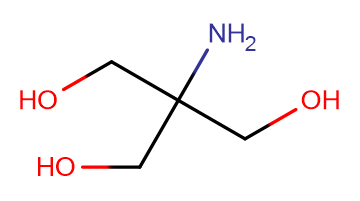
Trometamol
CAS No. 77-86-1
Trometamol( Tromethamine | NSC 6365 | NSC-6365 | NSC6365 )
Catalog No. M15939 CAS No. 77-86-1
Trometamol is a proton acceptor used to treat acidemia.
Purity : >98% (HPLC)
 COA
Datasheet
HNMR
HPLC
MSDS
Handing Instructions
COA
Datasheet
HNMR
HPLC
MSDS
Handing Instructions
| Size | Price / USD | Stock | Quantity |
| 1 mL x 10 mM in DMSO | 28 | In Stock |


|
| 100MG | 27 | In Stock |
|
| 200MG | 36 | In Stock |
|
| 500MG | 26 | In Stock |
|
| 1G | Get Quote | In Stock |
|
Biological Information
-
Product NameTrometamol
-
NoteResearch use only, not for human use.
-
Brief DescriptionTrometamol is a proton acceptor used to treat acidemia.
-
DescriptionTrometamol is a proton acceptor used to treat acidemia.
-
In Vitro——
-
In Vivo——
-
SynonymsTromethamine | NSC 6365 | NSC-6365 | NSC6365
-
PathwayOthers
-
TargetOther Targets
-
RecptorOthers
-
Research AreaOther Indications
-
Indication——
Chemical Information
-
CAS Number77-86-1
-
Formula Weight121.14
-
Molecular FormulaC4H11NO3
-
Purity>98% (HPLC)
-
SolubilityWater: 24 mg/mL (198.11 mM); DMSO: 2 mg/mL (16.5 mM)
-
SMILESOCC(CO)(N)CO
-
Chemical Name1,3-Propanediol, 2-amino-2-(hydroxymethyl)-
Shipping & Storage Information
-
Storage(-20℃)
-
ShippingWith Ice Pack
-
Stability≥ 2 years
Reference
1. MH, et al. Acta Anaesthesiol Scand, 2000, 44(5), 524-527.
molnova catalog



related products
-
1,3-Benzoxazole-6-ca...
1,3-Benzoxazole-6-carboxylic acid is a chemical compound.
-
MAO-IN-M30 dihydroch...
Potent and brain selective monoamine oxidase (MAO) inhibitor (EC50 values are 37 and 57 nM for MAO-A and MAO-B, respectively).
-
Vopratelimab
Vopratelimab (JTX-2011) is a selective humanized immunoglobulin G1-kappa monoclonal antibody and a potent ICOS agonist with high affinity for inducible T cell co-stimulating factors (ICOS), showing affinities of 0.93 nM for hICOS, 3.7 nM for rat ICOS, and 0.64 nM for mICOS.
