


 Cart
Cart
 sales@molnova.com



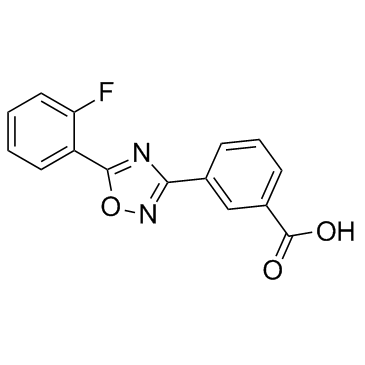
Ataluren
CAS No. 775304-57-9
Ataluren ( PTC124 )
Catalog No. M15929 CAS No. 775304-57-9
PTC124 (Ataluren) selectively induces ribosomal read-through of premature but not normal termination codons, with EC50 of 0.1 μM.
Purity : >98% (HPLC)
 COA
Datasheet
HNMR
HPLC
MSDS
Handing Instructions
COA
Datasheet
HNMR
HPLC
MSDS
Handing Instructions
| Size | Price / USD | Stock | Quantity |
| 1 mL x 10 mM in DMSO | 39 | In Stock |


|
| 5MG | 30 | In Stock |
|
| 10MG | 49 | In Stock |
|
| 25MG | 81 | In Stock |
|
| 50MG | 117 | In Stock |
|
| 100MG | 184 | In Stock |
|
| 200MG | 220 | In Stock |
|
| 500MG | 370 | In Stock |
|
| 1G | Get Quote | In Stock |
|
Biological Information
-
Product NameAtaluren
-
NoteResearch use only, not for human use.
-
Brief DescriptionPTC124 (Ataluren) selectively induces ribosomal read-through of premature but not normal termination codons, with EC50 of 0.1 μM.
-
DescriptionPTC124 (Ataluren) selectively induces ribosomal read-through of premature but not normal termination codons, with EC50 of 0.1 μM, may provide treatment for genetic disorders caused by nonsense mutations (e.g. CF caused by CFTR nonsense mutation).(In Vitro):This premature “stop” signal (a class I mutation) prevents the cell from producing a full-length CFTR protein. Ataluren (PTC124)-a new chemical entity that selectively induces ribosomal readthrough of premature but not normal termination codons. (In Vivo):Ataluren (PTC124) activity, optimized using nonsense-containing reporters, promotes dystrophin production in primary muscle cells from humans and mdx mice expressing dystrophin nonsense alleles, and rescues striated muscle function in mdx mice within 2-8 weeks of drug exposure. Ataluren (PTC124) is well tolerated in animals at plasma exposures substantially in excess of those required for nonsense suppression. To induce nonsense suppression and increase PPT1 enzyme activity, the read-through drug Ataluren (PTC124) is given via intraperitoneal (i.p.) injection to male Cln1R151X mice at 2 months of age. These treatments are performed four times daily for 2 consecutive days in a proof-of-principle study. Used at 10 mg/kg, Ataluren (PTC124) increased PPT1 enzyme activity (P=0.0001 by unpaired t-test) and protein level (P=0.0014 by unpaired t-test) in the liver, but did not increase PPT1 enzyme activity or protein level in the cortex. This tissue-specific effect is likely due to the inability of Ataluren (PTC124) to breach the blood brain barrier (BBB), which decreased the bioavailability of Ataluren (PTC124) within the brain, and prevented Ataluren (PTC124) from reaching an efficacious concentration within the therapeutic window.
-
In VitroThis premature “stop” signal (a class I mutation) prevents the cell from producing a full-length CFTR protein. Ataluren (PTC124)-a new chemical entity that selectively induces ribosomal readthrough of premature but not normal termination codons.
-
In VivoAtaluren (PTC124) activity, optimized using nonsense-containing reporters, promotes dystrophin production in primary muscle cells from humans and mdx mice expressing dystrophin nonsense alleles, and rescues striated muscle function in mdx mice within 2-8 weeks of drug exposure. Ataluren (PTC124) is well tolerated in animals at plasma exposures substantially in excess of those required for nonsense suppression. To induce nonsense suppression and increase PPT1 enzyme activity, the read-through drug Ataluren (PTC124) is given via intraperitoneal (i.p.) injection to male Cln1R151X mice at 2 months of age. These treatments are performed four times daily for 2 consecutive days in a proof-of-principle study. Used at 10 mg/kg, Ataluren (PTC124) increased PPT1 enzyme activity (P=0.0001 by unpaired t-test) and protein level (P=0.0014 by unpaired t-test) in the liver, but did not increase PPT1 enzyme activity or protein level in the cortex. This tissue-specific effect is likely due to the inability of Ataluren (PTC124) to breach the blood brain barrier (BBB), which decreased the bioavailability of Ataluren (PTC124) within the brain, and prevented Ataluren (PTC124) from reaching an efficacious concentration within the therapeutic window.
-
SynonymsPTC124
-
PathwayApoptosis
-
TargetCFTR
-
RecptorCFTR
-
Research AreaMetabolic Disease
-
Indication——
Chemical Information
-
CAS Number775304-57-9
-
Formula Weight284.24
-
Molecular FormulaC15H9FN2O3
-
Purity>98% (HPLC)
-
SolubilityDMSO: 57 mg/mL (200.53 mM)
-
SMILESO=C(O)C1=CC=CC(C2=NOC(C3=CC=CC=C3F)=N2)=C1
-
Chemical Name3-[5-(2-fluorophenyl)-1,2,4-oxadiazol-3-yl]benzoic acid
Shipping & Storage Information
-
Storage(-20℃)
-
ShippingWith Ice Pack
-
Stability≥ 2 years
Reference
1.Welch EM, et al. Nature, 2007, 447(7140), 87-9
molnova catalog



related products
-
Ivacaftor
Ivacaftor (VX-770, VX770) is a potent, orally bioavailable CFTR potentiator, increases G551D- and F508del CFTR-mediated Cl- secretion with EC50 of 100 nM.
-
UCCF-853
UCCF-853 is a small-molecule CFTR modulator that can be used to study cystic fibrosis.
-
GLPG-1837
GLPG-1837 (ABBV-974)?is a potent, orally available CFTR potentiator with EC50 of 3 nM and 339 nM on F508del and G551D CFTR, respectively.
