


 Cart
Cart
 sales@molnova.com



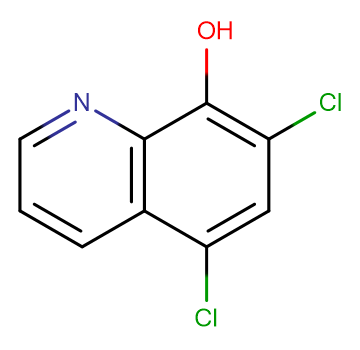
Capitrol
CAS No. 773-76-2
Capitrol( chloroxine hydrofluoride | chlorquinol | dichlorohydroxyquinoline | dichloroquine | quixalin )
Catalog No. M15923 CAS No. 773-76-2
Chloroxine is a synthetic antibacterial compound that is effective in the treatment of dandruff and seborrheic dermatitis when incorporated in a shampoo.
Purity : >98% (HPLC)
 COA
Datasheet
HNMR
HPLC
MSDS
Handing Instructions
COA
Datasheet
HNMR
HPLC
MSDS
Handing Instructions
| Size | Price / USD | Stock | Quantity |
| 1 mL x 10 mM in DMSO | 28 | In Stock |


|
| 100MG | Get Quote | In Stock |
|
| 200MG | Get Quote | In Stock |
|
| 500MG | 29 | In Stock |
|
| 1G | 37 | In Stock |
|
Biological Information
-
Product NameCapitrol
-
NoteResearch use only, not for human use.
-
Brief DescriptionChloroxine is a synthetic antibacterial compound that is effective in the treatment of dandruff and seborrheic dermatitis when incorporated in a shampoo.
-
DescriptionChloroxine is a synthetic antibacterial compound that is effective in the treatment of dandruff and seborrheic dermatitis when incorporated in a shampoo.(In Vitro):By using the Jouyban-Acree model, the Chloroxine solubility is well correlated obtaining RAD values lower than 3.64% and RMSD values lower than 8.82 × 10 6. Chloroxine is preferentially solvated by water for the studied mixtures in water-rich compositions; while within intermediate and co-solvent-rich compositions, Chloroxine is preferentially solvated by DMSO (DMF, NMP or 1,4-dioxane) in DMSO (DMF, NMP or 1,4-dioxane) + water mixtures. It is shown that the change in solvent-solvent interaction energy accounted by cavity term governed the solubility variation of Chloroxine in all aqueous mixtures.
-
In VitroBy using the Jouyban-Acree model, the Chloroxine solubility is well correlated obtaining RAD values lower than 3.64% and RMSD values lower than 8.82?×?10?6. Chloroxine is preferentially solvated by water for the studied mixtures in water-rich compositions; while within intermediate and co-solvent-rich compositions, Chloroxine is preferentially solvated by DMSO (DMF, NMP or 1,4-dioxane) in DMSO (DMF, NMP or 1,4-dioxane)?+?water mixtures. It is shown that the change in solvent-solvent interaction energy accounted by cavity term governed the solubility variation of Chloroxine in all aqueous mixtures.
-
In Vivo——
-
Synonymschloroxine hydrofluoride | chlorquinol | dichlorohydroxyquinoline | dichloroquine | quixalin
-
PathwayOthers
-
TargetOther Targets
-
RecptorOthers
-
Research AreaInfection
-
Indication——
Chemical Information
-
CAS Number773-76-2
-
Formula Weight214.05
-
Molecular FormulaC9H5Cl2NO
-
Purity>98% (HPLC)
-
SolubilityDMSO: 43 mg/mL (200.88 mM)
-
SMILESC1=CC2=C(C(=C(C=C2Cl)Cl)O)N=C1
-
Chemical Name5,7-dichloroquinolin-8-ol
Shipping & Storage Information
-
Storage(-20℃)
-
ShippingWith Ice Pack
-
Stability≥ 2 years
Reference
1.Malaveille C, et al. IARC Sci Publ. 1991;(115):261-6.
molnova catalog



related products
-
Marmin
Marmin have anti-ulcer effects, which are ascribed primarily to the maintenance of the mucosal barrier integrity and inhibition of gastric motor activity and secondarily due to the prevention of the effects of endogenous acetylcholine and histamine.
-
AtPep3
AtPep3 is a hormone-like peptide that plays a role in the salinity stress tolerance of plants.
-
Calcium glycerophosp...
Calcium glycerophosphate(CaGP) is an inhibitor of intestinal alkaline phosphatase F3. Calcium glycerophosphate can be a source of calcium and phosphorus in total parenteral nutrition solutions .
