


 Cart
Cart
 sales@molnova.com



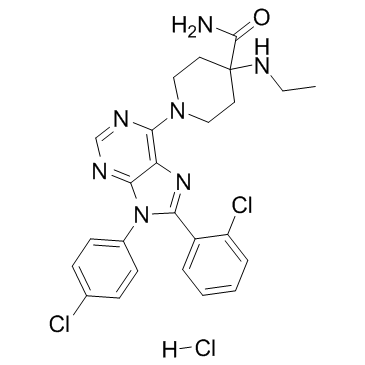
Otenabant hydrochloride
CAS No. 686347-12-6
Otenabant hydrochloride( CP 945598 Hydrochloride | CP-945598 Hydrochloride | CP945598 Hydrochloride )
Catalog No. M15623 CAS No. 686347-12-6
A potent, and selective CB1 receptor antagonist with Ki of 0.7 nM/0.12 nM in binding and functional assays respectively.
Purity : >98% (HPLC)
 COA
Datasheet
HNMR
HPLC
MSDS
Handing Instructions
COA
Datasheet
HNMR
HPLC
MSDS
Handing Instructions
| Size | Price / USD | Stock | Quantity |
| 2MG | 51 | In Stock |


|
| 5MG | 70 | In Stock |
|
| 10MG | 117 | In Stock |
|
| 25MG | 239 | In Stock |
|
| 50MG | 433 | In Stock |
|
| 100MG | 635 | In Stock |
|
| 200MG | Get Quote | In Stock |
|
| 500MG | Get Quote | In Stock |
|
| 1G | Get Quote | In Stock |
|
Biological Information
-
Product NameOtenabant hydrochloride
-
NoteResearch use only, not for human use.
-
Brief DescriptionA potent, and selective CB1 receptor antagonist with Ki of 0.7 nM/0.12 nM in binding and functional assays respectively.
-
DescriptionA potent, and selective CB1 receptor antagonist with Ki of 0.7 nM/0.12 nM in binding and functional assays respectively; has low affinity (Ki=7600 nM) for human CB2 receptors; reverses cannabinoid agonist mediated responses, reduces food intake, and increases energy expenditure and fat oxidation in rodents.Obesity Phase 3 Discontinued(In Vitro):Otenabant HCl has low affinity with Ki of 7.6 μM for human CB2 receptors. Otenabant HCl inhibits CB1 receptor with moderate unbound microsomal clearance, low hERG affinity, and adequate CNS penetration.(In Vivo):Otenabant acutely stimulates energy expenditure in rats and decreases the respiratory quotient indicating a metabolic switch to increased fat oxidation. Otenabant (10 mg/kg, p.o.) promotes a 9%, vehicle adjusted weight loss in a 10 day weight loss study in diet-induced obese mice. Otenabant HCl reverses four cannabinoid agonistmediated behaviors (locomotor activity, hypothermia, analgesia, and catalepsy) following administration of the synthetic CB1 receptor agonist CP-55940. Otenabant HCl exhibits dose-dependent anorectic activity in a model of acute food intake in rodents and increased energy expenditure and fat oxidation.
-
In VitroOtenabant HCl has low affinity with Ki of 7.6 μM for human CB2 receptors. Otenabant HCl inhibits CB1 receptor with moderate unbound microsomal clearance, low hERG affinity, and adequate CNS penetration.
-
In VivoOtenabant acutely stimulates energy expenditure in rats and decreases the respiratory quotient indicating a metabolic switch to increased fat oxidation. Otenabant (10 mg/kg, p.o.) promotes a 9%, vehicle adjusted weight loss in a 10 day weight loss study in diet-induced obese mice. Otenabant HCl reverses four cannabinoid agonistmediated behaviors (locomotor activity, hypothermia, analgesia, and catalepsy) following administration of the synthetic CB1 receptor agonist CP-55940. Otenabant HCl exhibits dose-dependent anorectic activity in a model of acute food intake in rodents and increased energy expenditure and fat oxidation.
-
SynonymsCP 945598 Hydrochloride | CP-945598 Hydrochloride | CP945598 Hydrochloride
-
PathwayGPCR/G Protein
-
TargetCannabinoid Receptor
-
RecptorhCB1|hCB2|rCB1
-
Research AreaMetabolic Disease
-
IndicationObesity
Chemical Information
-
CAS Number686347-12-6
-
Formula Weight546.8792
-
Molecular FormulaC25H26Cl3N7O
-
Purity>98% (HPLC)
-
SolubilityDMSO: 1 mg/mL
-
SMILESCCNC1(CCN(CC1)C1=NC=NC2=C1NC(N2C1=CC=C(Cl)C=C1)C1=CC=CC=C1Cl)C(N)=O
-
Chemical Name4-Piperidinecarboxamide, 1-[8-(2-chlorophenyl)-9-(4-chlorophenyl)-9H-purin-6-yl]-4-(ethylamino)-, hydrochloride (1:1)
Shipping & Storage Information
-
Storage(-20℃)
-
ShippingWith Ice Pack
-
Stability≥ 2 years
Reference
1. Fulp A, et al. J Med Chem. 2012 Nov 26;55(22):10022-32.
2. Hadcock JR, et al. Biochem Biophys Res Commun. 2010 Apr 2;394(2):366-71.
3. Aronne LJ, et al. Obesity (Silver Spring). 2011 Jul;19(7):1404-14.
molnova catalog



related products
-
RVD-Hpα
N-terminally extended form of human hemopressin that acts as a selective CB1 receptor agonist. Increases intracellular Ca2+ levels in cells expressing CB1 receptors in vitro. Also high affinity CB2 positive allosteric modulator (Ki = 50 nM).
-
Fatostatin
Fatostatin ia an inhibitor of sterol regulatory element binding protein (SREBP). It impairs the activation of SREBP-1 and SREBP-2.
-
OMDM-5
OMDM-5 is a potent vanilloid receptor type 1 (TRPV1, EC50 = 75 nM) agonist, showing weak ligand activity at cannabinoid type 1 receptor (CB1, Ki=4.9 μM).
