


 Cart
Cart
 sales@molnova.com



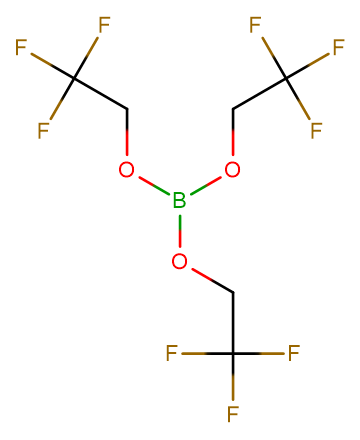
Tris(2,2,2-trifluoroethyl) borate
CAS No. 659-18-7
Tris(2,2,2-trifluoroethyl) borate( —— )
Catalog No. M15508 CAS No. 659-18-7
Tris(2,2,2-trifluoroethyl) borate is mostly used in condensation reactions.
Purity : >98% (HPLC)
 COA
Datasheet
HNMR
HPLC
MSDS
Handing Instructions
COA
Datasheet
HNMR
HPLC
MSDS
Handing Instructions
| Size | Price / USD | Stock | Quantity |
| 25MG | 44 | In Stock |


|
| 50MG | 75 | In Stock |
|
| 100MG | 128 | In Stock |
|
| 200MG | 194 | In Stock |
|
| 500MG | Get Quote | In Stock |
|
| 1G | Get Quote | In Stock |
|
Biological Information
-
Product NameTris(2,2,2-trifluoroethyl) borate
-
NoteResearch use only, not for human use.
-
Brief DescriptionTris(2,2,2-trifluoroethyl) borate is mostly used in condensation reactions.
-
DescriptionTris(2,2,2-trifluoroethyl) borate is mostly used in condensation reactions. It has been shown to promote the direct formation of amides from carboxylic acids and amines as well as the formation of imines from amines or amides with carbonyl compounds.
-
In Vitro——
-
In Vivo——
-
Synonyms——
-
PathwayOthers
-
TargetOther Targets
-
RecptorOthers
-
Research Area——
-
Indication——
Chemical Information
-
CAS Number659-18-7
-
Formula Weight307.91
-
Molecular FormulaC6H6BF9O3
-
Purity>98% (HPLC)
-
SolubilityDMSO: > 11 mM
-
SMILESFC(F)(F)COB(OCC(F)(F)F)OCC(F)(F)F
-
Chemical Name——
Shipping & Storage Information
-
Storage(-20℃)
-
ShippingWith Ice Pack
-
Stability≥ 2 years
Reference
1.Rait JL. Aust N Z J Ophthalmol. 1999, 27(1):57-64.
molnova catalog



related products
-
Mangostenol peroxide
Mangostenol peroxide
-
Alfacalcidol
Alfacalcidol (1-hydroxycholecalciferol; Alpha D3; 1.alpha.-Hydroxyvitamin D3) is a non-selective VDR activator medication.
-
Arjunglucoside II
Arjunglucoside II exhibits a moderate free radical scavenging activity.
