


 Cart
Cart
 sales@molnova.com



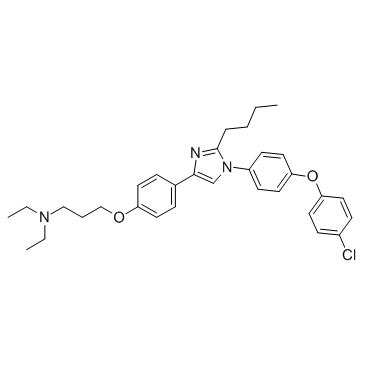
Azeliragon
CAS No. 603148-36-3
Azeliragon( TTP-488 | PF-04494700 )
Catalog No. M15253 CAS No. 603148-36-3
An orally bioavailable small molecule inhibitor of RAGE.
Purity : >98% (HPLC)
 COA
Datasheet
HNMR
HPLC
MSDS
Handing Instructions
COA
Datasheet
HNMR
HPLC
MSDS
Handing Instructions
| Size | Price / USD | Stock | Quantity |
| 1 mL x 10 mM in DMSO | 52 | In Stock |


|
| 2MG | 31 | In Stock |
|
| 5MG | 45 | In Stock |
|
| 10MG | 76 | In Stock |
|
| 25MG | 141 | In Stock |
|
| 50MG | 245 | In Stock |
|
| 100MG | 397 | In Stock |
|
| 200MG | Get Quote | In Stock |
|
| 500MG | Get Quote | In Stock |
|
| 1G | Get Quote | In Stock |
|
Biological Information
-
Product NameAzeliragon
-
NoteResearch use only, not for human use.
-
Brief DescriptionAn orally bioavailable small molecule inhibitor of RAGE.
-
DescriptionAn orally bioavailable small molecule inhibitor of RAGE; inhibits sRAGE from binding to RAGE ligands, S100b, amphoterin and carboxymethyl-lysine; has been shown to inhibit the binding of sRAGE to Aβ1-42 in a fluorescent polarization assay; reduces accumulation in the spleen of Aβ peptides and the expression of IL-6 and macrophage colony stimulating factor, reduces both inflammatory markers (TNF-α, TGF-β and IL-1) and CNS amyloid deposition.Alzheimer's Disease Phase 3 Clinical(In Vitro):Azeliragon (4 nM; 16 hours; T cells) treatment inhibits of wild type mice (WT) but not the deletion of the receptor (RAGE-/- mice) T cells and significant reduction in the production of IFN-γ.(In Vivo):Azeliragon (100 mcg/d; intraperitoneal injection; every day) treatment reduces syngeneic islet graft and islet allograft in NOD and B6 mice (Islets were isolated from young prediabetic NOD/LtJ mice and transplanted into NOD mice with spontaneous diabetes; islets were isolated from WT BALB/c mice and transplanted into B6 mice with diabetes).
-
In VitroAzeliragon (4 nM; 16 hours; T cells) treatment inhibits of wild type mice (WT) but not the deletion of the receptor (RAGE-/- mice) T cells and significant reduction in the production of IFN-γ. Cell Viability Assay Cell Line:Purified T cells from RAGE-/- or WT B6 mice.Concentration:4 nM Incubation Time:16 hours Result:Inhibited of WT but not RAGE-/- T cells, and significantly reduced the level of IFN-γ.
-
In VivoAzeliragon (100 mcg/d; intraperitoneal injection; every day) treatment reduces syngeneic islet graft and islet allograft in NOD and B6 mice (Islets were isolated from young prediabetic NOD/LtJ mice and transplanted into NOD mice with spontaneous diabetes; islets were isolated from WT BALB/c mice and transplanted into B6 mice with diabetes). Animal Model:Prediabetic NOD/LtJ (6-7 week old) mice, NOD mice with spontaneous diabetes, WT BALB/c mice (8-10 week old) and B6 mice with diabetes .Dosage:100 mcg/d Administration:Intraperitoneal injection; every day Result:Prolonged islet auto and allograft survival.
-
SynonymsTTP-488 | PF-04494700
-
PathwayOthers
-
TargetOther Targets
-
RecptorRAGE
-
Research AreaNeurological Disease
-
IndicationAlzheimer Disease
Chemical Information
-
CAS Number603148-36-3
-
Formula Weight532.116
-
Molecular FormulaC32H38ClN3O2
-
Purity>98% (HPLC)
-
Solubility10 mM in DMSO
-
SMILESCCCCC1=NC(=CN1C2=CC=C(C=C2)OC3=CC=C(C=C3)Cl)C4=CC=C(C=C4)OCCCN(CC)CC
-
Chemical Name1-Propanamine, 3-[4-[2-butyl-1-[4-(4-chlorophenoxy)phenyl]-1H-imidazol-4-yl]phenoxy]-N,N-diethyl-
Shipping & Storage Information
-
Storage(-20℃)
-
ShippingWith Ice Pack
-
Stability≥ 2 years
Reference
1. Sabbagh MN, et al. Alzheimer Dis Assoc Disord. 2011 Jul-Sep;25(3):206-12.
2. Chen Y, et al. J Immunol. 2008 Sep 15;181(6):4272-8.
3. Burstein AH, et al. BMC Neurol. 2014 Jan 15;14:12.
molnova catalog



related products
-
Cortistatin-14 TFA
Cortistatin-14 is a neuropeptide have structural similarity to somatostatin-14. It is produced in the cortex and hippocampus of central nervous system.
-
DNQX Disodium
DNQX Disodium is a water-soluble form of selective antagonist of non-NMDA receptor.
-
PUMA BH3 (TFA)
PUMA BH3 (TFA) is a p53 upregulated modulator of apoptosis (PUMA) BH3 domain peptide, acts as a direct activator of Bak, with a Kd of 26 nM.
