


 Cart
Cart
 sales@molnova.com



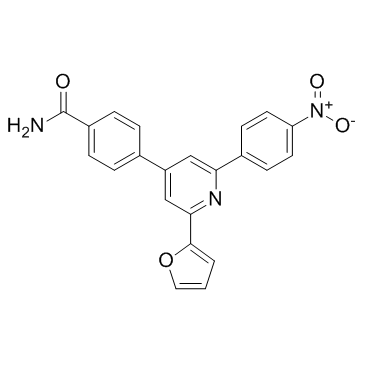
KJ-Pyr-9
CAS No. 581073-80-5
KJ-Pyr-9( KJ Pyr9 )
Catalog No. M15131 CAS No. 581073-80-5
KJ-Pyr-9 is a novel small-molecule inhibitor of c-Myc (Kd=6.5 ± 1.0 nM).
Purity : >98% (HPLC)
 COA
Datasheet
HNMR
HPLC
MSDS
Handing Instructions
COA
Datasheet
HNMR
HPLC
MSDS
Handing Instructions
| Size | Price / USD | Stock | Quantity |
| 1 mL x 10 mM in DMSO | 54 | In Stock |


|
| 2MG | 31 | In Stock |
|
| 5MG | 49 | In Stock |
|
| 10MG | 70 | In Stock |
|
| 25MG | 141 | In Stock |
|
| 50MG | 272 | In Stock |
|
| 100MG | 498 | In Stock |
|
| 200MG | 669 | In Stock |
|
| 500MG | 1042 | In Stock |
|
| 1G | Get Quote | In Stock |
|
Biological Information
-
Product NameKJ-Pyr-9
-
NoteResearch use only, not for human use.
-
Brief DescriptionKJ-Pyr-9 is a novel small-molecule inhibitor of c-Myc (Kd=6.5 ± 1.0 nM).
-
DescriptionKJ-Pyr-9 is a novel small-molecule inhibitor of c-Myc (Kd=6.5 ± 1.0 nM); interferes with MYC-MAX complex formation and inhibits MYC-induced oncogenic transformation in cells; active in xenograft mice.
-
In Vitro——
-
In Vivo——
-
SynonymsKJ Pyr9
-
PathwayCell Cycle/DNA Damage
-
Targetc-Myc
-
Recptorc-Myc
-
Research AreaCancer
-
Indication——
Chemical Information
-
CAS Number581073-80-5
-
Formula Weight385.3722
-
Molecular FormulaC22H15N3O4
-
Purity>98% (HPLC)
-
Solubility10 mM in DMSO
-
SMILESO=C(N)C1=CC=C(C2=CC(C3=CC=CO3)=NC(C4=CC=C([N+]([O-])=O)C=C4)=C2)C=C1
-
Chemical NameBenzamide, 4-[2-(2-furanyl)-6-(4-nitrophenyl)-4-pyridinyl]-
Shipping & Storage Information
-
Storage(-20℃)
-
ShippingWith Ice Pack
-
Stability≥ 2 years
Reference
1. Hart JR, et al. Proc Natl Acad Sci U S A. 2014 Aug 26;111(34):12556-61.
2. Raffeiner P, et al. Oncotarget. 2014 Oct 15;5(19):8869-78.
molnova catalog



related products
-
MYCMI-6
MYCMI-6 (NSC354961) is a selective, high affinity inhibitor of MYC-MAX interaction.
-
IRES-C11
A novel, spectfic c-Myc IRES (internal ribosome entry site) function inhibitor that prevents binding of hnRNP A1 to the Myc IRES and specifically inhibits Myc IRES activity in MM cells.
-
MYCi975
MYCi975 is an orally active inhibitor of MYC.MYCi975 inhibits P493-6, MV411,SK-N-B2 cells viability in an MYC-dependent manner(IC50s of 3.7, 3.9, 6.4 μM, respectively).The initial lead, MYC inhibitor 361 (MYCi361), suppressed in vivo tumor growth in mice, increased tumor immune cell infiltration, upregulated PD-L1 on tumors, and sensitized tumors to anti-PD1 immunotherapy. However, 361 demonstrated a narrow therapeutic index.
