


 Cart
 sales@molnova.com




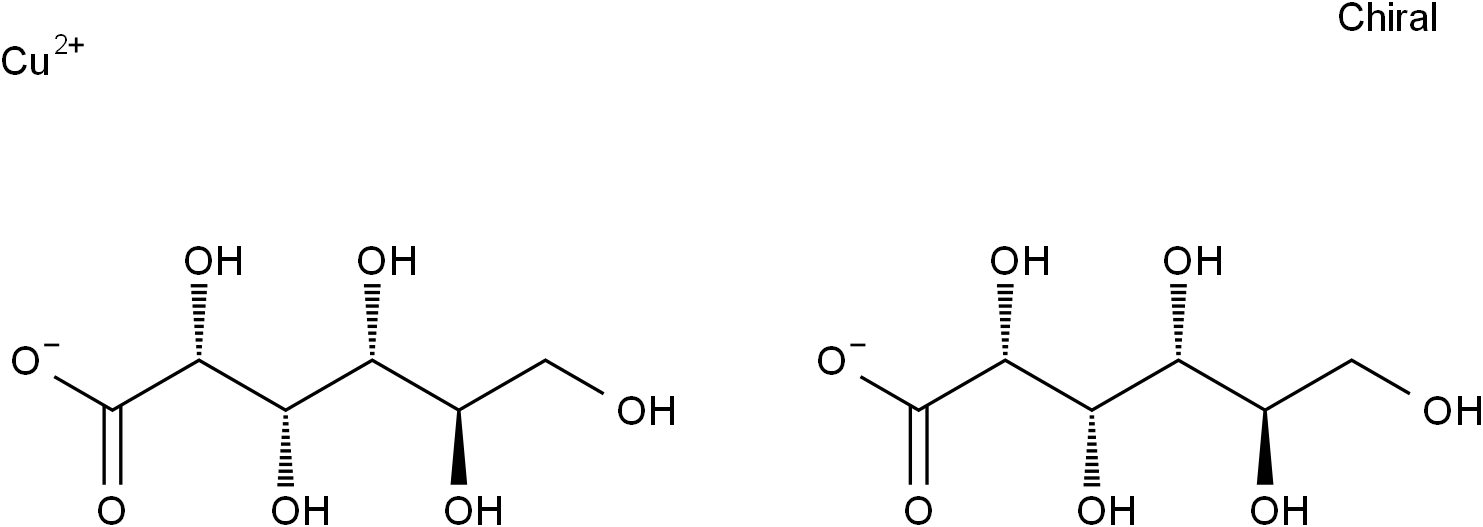
Copper(II) D-gluconate
CAS No. 527-09-3
Copper(II) D-gluconate( —— )
Catalog No. M14869 CAS No. 527-09-3
Copper(II) D-gluconate powder in combination with silicon was used for the fabrication of carbon coated Si-Cu3Si composite as the anode materials for Li-ion batteries.
Purity : >98% (HPLC)
 COA
Datasheet
HNMR
HPLC
MSDS
Handing Instructions
| Size | Price / USD | Stock | Quantity |
| 100MG | Get Quote | In Stock |


|
| 200MG | Get Quote | In Stock |
|
| 500MG | Get Quote | In Stock |
|
| 1G | 31 | In Stock |
|
Biological Information
-
Product NameCopper(II) D-gluconate
-
NoteResearch use only, not for human use.
-
Brief DescriptionCopper(II) D-gluconate powder in combination with silicon was used for the fabrication of carbon coated Si-Cu3Si composite as the anode materials for Li-ion batteries.
-
DescriptionCopper(II) D-gluconate powder in combination with silicon was used for the fabrication of carbon coated Si-Cu3Si composite as the anode materials for Li-ion batteries.
-
In Vitro——
-
In Vivo——
-
Synonyms——
-
PathwayOthers
-
TargetOther Targets
-
Recptor——
-
Research Area——
-
Indication——
Chemical Information
-
CAS Number527-09-3
-
Formula Weight453.84
-
Molecular FormulaC12H22CuO14
-
Purity>98% (HPLC)
-
SolubilityIn Vitro:?DMSO : 25 mg/mL (55.09 mM)
-
SMILESC([C@H]([C@H]([C@@H]([C@H](C(=O)[O-])O)O)O)O)O.C([C@H]([C@H]([C@@H]([C@H](C(=O)[O-])O)O)O)O)O.[Cu+2]
-
Chemical Name——
Shipping & Storage Information
-
Storage(-20℃)
-
ShippingWith Ice Pack
-
Stability≥ 2 years
Reference
molnova catalog



related products
-
Fluoronaphthalene
Incompatible with strong oxidizing agents.
-
JTS-653
JTS-653 is a highly potent and selective transient receptor potential vanilloid 1 (TRPV1) antagonist in vitro and in vivo. JTS-653 attenuates chronic pain refractory to non-steroidal anti-inflammatory agents.
-
Protirelin Acetate
Protirelin Acetate is a highly conserved neuropeptide that exerts the hormonal control of thyroid-stimulating hormone (TSH) levels as well as neuromodulatory functions.Protirelin (TRH) is an evolutionarily ancient neuropeptide, having its origin before the divergence of protostomes and deuterostomes, and may ancestrally have been involved in the control of postembryonic growth and reproduction
