


 Cart
Cart
 sales@molnova.com



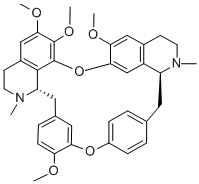
Tetrandrine
CAS No. 518-34-3
Tetrandrine( NSC 77037 | Fanchinine )
Catalog No. M14813 CAS No. 518-34-3
Tetrandrine (NSC 77037;Fanchinine) is a bis-benzylisoquinoline alkaloid that acts a calcium channel blocker.
Purity : >98% (HPLC)
 COA
Datasheet
HNMR
HPLC
MSDS
Handing Instructions
COA
Datasheet
HNMR
HPLC
MSDS
Handing Instructions
| Size | Price / USD | Stock | Quantity |
| 1 mL x 10 mM in DMSO | 43 | In Stock |


|
| 100MG | 40 | In Stock |
|
| 200MG | Get Quote | In Stock |
|
| 500MG | 83 | In Stock |
|
| 1G | Get Quote | In Stock |
|
Biological Information
-
Product NameTetrandrine
-
NoteResearch use only, not for human use.
-
Brief DescriptionTetrandrine (NSC 77037;Fanchinine) is a bis-benzylisoquinoline alkaloid that acts a calcium channel blocker.
-
DescriptionTetrandrine (NSC 77037;Fanchinine) is a bis-benzylisoquinoline alkaloid that acts a calcium channel blocker (IC50= 8 and 20 uM for L-type and T-type calcium channels, respectively) and induces apoptosis; produces anti-inflammatory, immunomodulating, anti-proliferative, and free radical scavenging effects; has also been shown to increase glucose utilization by enhancing hepatocyte glycogen synthesis; a potent cell autophagy agonist.Lung Cancer Phase 3 Clinical(In Vitro):The effects of Tetrandrine (NSC-77037), a bis-benzyl-isoquinoline alkaloid, on voltage-gated Ca2+ currents (ICa) and on Ca2+-activated K+ current (IK(Ca)) and channels in isolated nerve terminals of the rat neurohypophysis are investigated using patch-clamp techniques. The non-inactivating component of ICa is inhibited by external Tetrandrine (NSC-77037) in a voltage- and dose-dependent manner, with an IC50=10.1μM. Tetrandrine (NSC-77037) decreases the channel-open probability, within bursts, with an IC50=0.21 μM. To evaluate the effects of Tetrandrine on HCC cells, Huh7, HCCLM9 and Hep3B cells are treated with 0 (DMSO), 0.5, 1, 2 or 4 μM of Tetrandrine for 24 h. The cell proliferation assay indicates that Tetrandrine exhibits almost no effect on the inhibition of HCC cell proliferation at 0.5-2 μM. However, Tetrandrine (NSC-77037) inhibits HCC cell migration in a dose-dependent manner. Furthermore, a wound-healing and transwell assay shows that 2 μM Tetrandrine significantly inhibits HCC cell migration and invasion.(In Vivo):To evaluate the effect of Tetrandrine (NSC-77037) on the inhibition of tumor metastasis in vivo, HCCLM9 subcutaneous tumor xenograft models is established with athymic nude mice. When the tumor volume reach approximately 50 mm3, nude mice are orally administered vehicle or Tetrandrine (NSC-77037) (30 mg/kg) every other day for 37 days. Tetrandrine (NSC-77037) treatment inhibits tumor growth by reducing the tumor volume and weight.
-
In VitroThe effects of Tetrandrine (NSC-77037), a bis-benzyl-isoquinoline alkaloid, on voltage-gated Ca2+ currents (ICa) and on Ca2+-activated K+ current (IK(Ca)) and channels in isolated nerve terminals of the rat neurohypophysis are investigated using patch-clamp techniques. The non-inactivating component of ICa is inhibited by external Tetrandrine (NSC-77037) in a voltage- and dose-dependent manner, with an IC50=10.1μM. Tetrandrine (NSC-77037) decreases the channel-open probability, within bursts, with an IC50=0.21 μM. To evaluate the effects of Tetrandrine on HCC cells, Huh7, HCCLM9 and Hep3B cells are treated with 0 (DMSO), 0.5, 1, 2 or 4 μM of Tetrandrine for 24 h. The cell proliferation assay indicates that Tetrandrine exhibits almost no effect on the inhibition of HCC cell proliferation at 0.5-2 μM. However, Tetrandrine (NSC-77037) inhibits HCC cell migration in a dose-dependent manner. Furthermore, a wound-healing and transwell assay shows that 2 μM Tetrandrine significantly inhibits HCC cell migration and invasion.
-
In VivoTo evaluate the effect of Tetrandrine (NSC-77037) on the inhibition of tumor metastasis in vivo, HCCLM9 subcutaneous tumor xenograft models is established with athymic nude mice. When the tumor volume reach approximately 50 mm3, nude mice are orally administered vehicle or Tetrandrine (NSC-77037) (30 mg/kg) every other day for 37 days. Tetrandrine (NSC-77037) treatment inhibits tumor growth by reducing the tumor volume and weight.
-
SynonymsNSC 77037 | Fanchinine
-
PathwayGPCR/G Protein
-
TargetCalcium Channel
-
RecptorCalciumChannel
-
Research AreaCancer
-
IndicationLung Cancer
Chemical Information
-
CAS Number518-34-3
-
Formula Weight622.8
-
Molecular FormulaC38H42N2O6
-
Purity>98% (HPLC)
-
SolubilityDMSO: 1 mg/mL (1.61 mM); Ethanol: 2 mg/mL (3.21 mM), warmed; Water: <1 mg/mL ( < 1 mg/ml refers to the product slightly soluble or insoluble )
-
SMILESCOC1=C(C2=C(C=C1OC)CCN(C)[C@]2(C3)[H])OC4=CC5=C(C=C4OC)CCN(C)[C@]5(CC6=CC=C(OC7=CC3=CC=C7OC)C=C6)[H]
-
Chemical Named-tetrandrine
Shipping & Storage Information
-
Storage(-20℃)
-
ShippingWith Ice Pack
-
Stability≥ 2 years
Reference
1. Xie QM, et al. Acta Pharmacol Sin. 2002 Dec;23(12):1107-13.
2. Yang Z, et al. Sci Rep. 2016 Jul 26;6:30263.
3. Wang H, et al. Cell Biosci. 2015 Jan 14;5:4.
molnova catalog



related products
-
Dimethadione
An anticonvulsant that is the active metabolite of trimethadine.
-
Diltiazem hydrochlor...
A postsynaptic muscle relaxant that inhibits Ca2+ ions release from sarcoplasmic reticulum stores; antagonizes ryanodine receptors.
-
(S)-(-)-Bay-K-8644
(S)-(-)-Bay-K-8644 is an agonist of L-type Ca2+ channel and activates Ba2+ currents with an EC50 of 32 nM.
