


 Cart
Cart
 sales@molnova.com



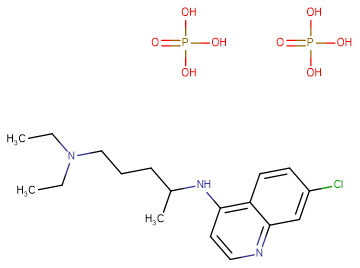
Chloroquine diphosphate
CAS No. 50-63-5
Chloroquine diphosphate( Aralen | DL-Chloroquine | NSC 14050 )
Catalog No. M14727 CAS No. 50-63-5
Chloroquine diphosphate is used as an antimalarial drug and also functions to increase sensitivity of tumor cells to radiation and chemotherapy via inducing autophagy .
Purity : >98% (HPLC)
 COA
Datasheet
HNMR
HPLC
MSDS
Handing Instructions
COA
Datasheet
HNMR
HPLC
MSDS
Handing Instructions
| Size | Price / USD | Stock | Quantity |
| 100MG | 38 | In Stock |


|
| 200MG | 45 | In Stock |
|
| 500MG | 59 | In Stock |
|
| 1G | Get Quote | In Stock |
|
Biological Information
-
Product NameChloroquine diphosphate
-
NoteResearch use only, not for human use.
-
Brief DescriptionChloroquine diphosphate is used as an antimalarial drug and also functions to increase sensitivity of tumor cells to radiation and chemotherapy via inducing autophagy .
-
DescriptionChloroquine diphosphate is used as an antimalarial drug and also functions to increase sensitivity of tumor cells to radiation and chemotherapy via inducing autophagy . Chloroquine diphosphate has been reported as an adjuvant for radiation and chemotherapy for inducing cell autophagy to anti-Y cells proliferation or metastasis . The mechanism of chloroquine diphosphate inducing cells autophagy is arresting cells in G1, up-regulates the expression of p27 and p53 while down-regulates the expression of CDK2 and cyclin D1 . Apart from anti-malarial, chloroquine diphosphate also has long been reported functioning in cell apoptosis. Pretreated CNE-2 human nasopharyngeal carcinoma cells with chloroquine diphosphate enhanced ionizing radiation induced cell apoptosis via increasing cells autophagic ratio . When treated with mouse breast Y 4T1 cells, chloroquine diphosphate treatment inhibited cellular proliferation and viability which resulted in cells apoptosis in a time- and dose- dependent manner . In human colon Y DLD-1 cells, combination of 5-FU and chloroquine diphosphate could inhibit cells proliferation via inducing autophagy.(In Vitro):Chloroquine (CHQ, 20 μM) inhibits IL-12p70 release and reduces Th1-priming capacity of activated human monocyte-derived Langerhans-like cells (MoLC). Chloroquine (CHQ, 20 μM) enhances IL-1–induced IL-23 secretion in MoLC and subsequently increases IL-17A release by primed CD4+ T cells. Chloroquine (25 μM) suppresses MMP-9 mRNA expression in normoxia and hypoxia in parental MDA-MB-231 cells. Chloroquine has cell-, dose- and hypoxia-dependent effects on MMP-2, MMP-9 and MMP-13 mRNA expression. TLR7 and TLR9 inhibition using IRS-954 or chloroquine significantly reduces HuH7 cell proliferation in vitro.Chloroquine (0.01-100 μM; 48 hours) potently blocks virus infection (vero E6 cells infected with SARS-CoV-2) at low-micromolar concentration (EC50= 1.13 μM). Chloroquine blocks virus infection by increasing endosomal pH required for virus/cell fusion, as well as interfering with the glycosylation of cellular receptors of SARS-CoV.(In Vivo):Chloroquine (80 mg/kg, i.p.) does not prevent the growth of the triple-negative MDA-MB-231 cells with high or low TLR9 expression levels in the orthotopic mouse model. TLR7 and TLR9 inhibition using IRS-954 or chloroquine significantly inhibits tumour growth in the mouse xenograft model. HCC development in the DEN/NMOR rat model is also significantly inhibited by chloroquine.
-
In Vitro——
-
In Vivo——
-
SynonymsAralen | DL-Chloroquine | NSC 14050
-
PathwayCell Cycle/DNA Damage
-
TargetATM/ATR
-
RecptorATM
-
Research AreaCancer
-
Indication——
Chemical Information
-
CAS Number50-63-5
-
Formula Weight515.87
-
Molecular FormulaC18H26CLN3·2(H3PO4)
-
Purity>98% (HPLC)
-
SolubilityWater: 100 mg/mL (193.85 mM)
-
SMILESOP(O)(O)=O.OP(O)(O)=O.CCN(CC)CCCC(C)NC1=C2C=CC(Cl)=CC2=NC=C1
-
Chemical Name——
Shipping & Storage Information
-
Storage(-20℃)
-
ShippingWith Ice Pack
-
Stability≥ 2 years
Reference
1. Gewirtz, D.A. Biochem Pharmacol, 2014. 90(3): 208-1
molnova catalog



related products
-
NU7026
NU7026 is a potent DNA-PK inhibitor with IC50 of 0.23 μM in cell-free assays.
-
AZD1390
AZD1390 (AZD-1390) is a novel potent, selective, orally available and CNS penetrant ATM inhibitor with IC50 of 0.78 nM.Brain Cancer,Phase 1 Clinical
-
CBP-93872
A potent G2 checkpoint inhibitor that specifically abrogates the DNA double-stranded break (DSB)-induced G2 checkpoint.
