


 Cart
Cart
 sales@molnova.com



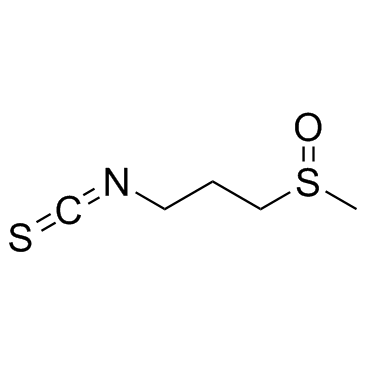
Iberin
CAS No. 505-44-2
Iberin( NSC 321801 )
Catalog No. M14724 CAS No. 505-44-2
Iberin is an isothiocyanate compound from horseradish that exhibits anticancer activity.
Purity : >98% (HPLC)
 COA
Datasheet
HNMR
HPLC
MSDS
Handing Instructions
COA
Datasheet
HNMR
HPLC
MSDS
Handing Instructions
| Size | Price / USD | Stock | Quantity |
| 5MG | 129 | In Stock |


|
| 10MG | 188 | In Stock |
|
| 25MG | 312 | In Stock |
|
| 50MG | 457 | In Stock |
|
| 100MG | 666 | In Stock |
|
| 200MG | Get Quote | In Stock |
|
| 500MG | 1376 | In Stock |
|
| 1G | Get Quote | In Stock |
|
Biological Information
-
Product NameIberin
-
NoteResearch use only, not for human use.
-
Brief DescriptionIberin is an isothiocyanate compound from horseradish that exhibits anticancer activity.
-
DescriptionIberin is an isothiocyanate compound from horseradish that exhibits anticancer activity, a quorum-sensing inhibitor (QSI) of the bacterial pathogen Pseudomonas aeruginosa, and significantly induces Nrf2 nuclear translocation in NIH3T3 fibroblasts; induces cell cycle arrest and apoptosis in human neuroblastoma cells associated with inhibition of expression of Cdk2, Cdk4, and Cdk6 proteins.
-
In VitroIberin inhibits the growth of neuroblastoma cells in a dose- and time-dependent manner. The iberin-induced cell cycle arrest in neuroblastoma cells is associated with inhibition of expression of cyclin-dependent kinase Cdk2, Cdk4, and Cdk6 proteins. There is an increase in apoptotic cell death in iberin treated cells as compared with control cells. The iberin-induced apoptosis is found to be associated with activation of caspase-9, caspase-3, and PARP. Iberin inhibits growth of human glioblastoma cells in cell proliferation assays, enhances cytotoxicity, and induces apoptosis by activation of caspase-3 and caspase-9.
-
In VivoIberin is tested in an in vivo foreign-body infection mouse model, and the results show no significantly difference in bacterial clearance between treated and nontreated miced. Iberin increases tissue levels of the phase II detoxification enzymes quinone reductase and glutathione S-transferase in a variety of rat tissues.
-
SynonymsNSC 321801
-
PathwayApoptosis
-
TargetApoptosis
-
RecptorApoptosis
-
Research Area——
-
Indication——
Chemical Information
-
CAS Number505-44-2
-
Formula Weight163.26106
-
Molecular FormulaC5H9NOS2
-
Purity>98% (HPLC)
-
SolubilityEthanol: 10 mg/mL
-
SMILESS=C=NCCCS(C)=O
-
Chemical NamePropane, 1-isothiocyanato-3-(methylsulfinyl)-
Shipping & Storage Information
-
Storage(-20℃)
-
ShippingWith Ice Pack
-
Stability≥ 2 years
Reference
1. Jadhav U, et al. Int J Mol Med. 2007 Mar;19(3):353-61.
2. Jadhav U, et al. J Pharmacol Sci. 2007 Feb;103(2):247-51.
3. Jakobsen TH, et al. Appl Environ Microbiol. 2012 Apr;78(7):2410-21.
4. Tan SY, et al. Antimicrob Agents Chemother. 2014 Nov;58(11):6648-59.
molnova catalog



related products
-
Glycerol trioleate
Glyceryl Trioleate has been investigated for the treatment of Adrenoleukodystrophy.
-
Lanperisone HCl
Lanperisone HCl (NK 433) is a novel orally available centrally acting muscle relaxant with anticancer activity and inhibits mono- and polysynaptic reflex potentials.
-
Flurochloridone
Flurochloridone is a selective herbicide. Flurochloridone induces apoptosis and is regulated by mitochondrial dysfunction and oxidative stresses.
