


 Cart
Cart
 sales@molnova.com



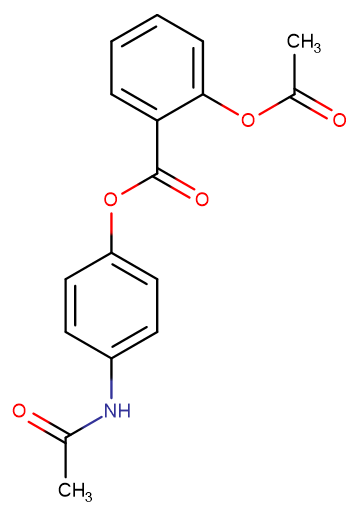
Benorilate
CAS No. 5003-48-5
Benorilate( Benorilate | Win-11450 | Win 11450 | Win11450 | TO125 | Salipran | Fenasparate )
Catalog No. M14678 CAS No. 5003-48-5
Benorylate (Benoral) is the esterification product of paracetamol and acetylsalicylic acid. It has anti-inflammatory, analgesic and antipyretic properties. Benorylate could also inhibit prostaglandin (PG) synthesis.
Purity : >98% (HPLC)
 COA
Datasheet
HNMR
HPLC
MSDS
Handing Instructions
COA
Datasheet
HNMR
HPLC
MSDS
Handing Instructions
| Size | Price / USD | Stock | Quantity |
| 1 mL x 10 mM in DMSO | 28 | In Stock |


|
| 100MG | Get Quote | In Stock |
|
| 200MG | Get Quote | In Stock |
|
| 500MG | Get Quote | In Stock |
|
| 1G | 27 | In Stock |
|
Biological Information
-
Product NameBenorilate
-
NoteResearch use only, not for human use.
-
Brief DescriptionBenorylate (Benoral) is the esterification product of paracetamol and acetylsalicylic acid. It has anti-inflammatory, analgesic and antipyretic properties. Benorylate could also inhibit prostaglandin (PG) synthesis.
-
DescriptionBenorylate (Benoral) is the esterification product of paracetamol and acetylsalicylic acid. It has anti-inflammatory, analgesic and antipyretic properties. Benorylate could also inhibit prostaglandin (PG) synthesis.(In Vitro):Benorylate (Salipran) is an esterified aspirin preparation whose antirheumatic properties are reported to be as good as those of aspirin.Benorylate (Salipran) causes a large decrease in the liver’s conversion rate of lactate into glucose, an important component of glucose homeostasis. Benorylate (Salipran) also impairs the urea synthesis rate from ammonia, another important function of the liver.(In Vivo):Benorylate (Salipran) is probably absorbed as the intact molecule which accounts for its good gastric tolerance.Benorylate (Salipran) could inhibit PG synthesis in laboratory animals and in human tissue.
-
In VitroBenorylate (Salipran) is an esterified aspirin preparation whose antirheumatic properties are reported to be as good as those of aspirin.Benorylate (Salipran) causes a large decrease in the liver’s conversion rate of lactate into glucose, an important component of glucose homeostasis. Benorylate (Salipran) also impairs the urea synthesis rate from ammonia, another important function of the liver.
-
In VivoBenorylate (Salipran) is probably absorbed as the intact molecule which accounts for its good gastric tolerance. Benorylate (Salipran) could inhibit PG synthesis in laboratory animals and in human tissue.
-
SynonymsBenorilate | Win-11450 | Win 11450 | Win11450 | TO125 | Salipran | Fenasparate
-
PathwayOthers
-
TargetOther Targets
-
RecptorOthers
-
Research AreaInflammation/Immunology
-
Indication——
Chemical Information
-
CAS Number5003-48-5
-
Formula Weight313.3
-
Molecular FormulaC17H15NO5
-
Purity>98% (HPLC)
-
SolubilitySoluble in DMSO
-
SMILESO=C(OC1=CC=C(NC(C)=O)C=C1)C2=CC=CC=C2OC(C)=O
-
Chemical Name4-acetamidophenyl 2-acetoxybenzoate
Shipping & Storage Information
-
Storage(-20℃)
-
ShippingWith Ice Pack
-
Stability≥ 2 years
Reference
1.Simila S et al. Eur J Pediatr. 1975 Dec 9;121(1):15-20.
molnova catalog



related products
-
Boc-Gly-Gly-Phe-Gly-...
Boc-Gly-Gly-Phe-Gly-OH TFA is a self-assembly of N-protected and C-protected tetrapeptides and is a protease cleaved connector for antibody-drug binding (ADC).
-
2-[(2-iodophenyl)for...
2-[(2-iodophenyl)formamido]acetic acid is a chemical compound.
-
Tyr-PDGF A-Chain (19...
Tyr-PDGF A-Chain (194-211)
