


 Cart
Cart
 sales@molnova.com



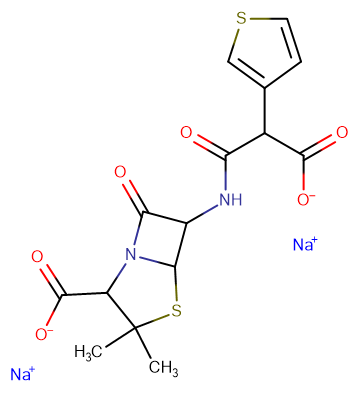
Ticarcillin disodium
CAS No. 4697-14-7
Ticarcillin disodium( —— )
Catalog No. M14564 CAS No. 4697-14-7
Ticarcillin disodium is an injectable antibiotic for the treatment of Gram-negative bacteria, particularly Pseudomonas aeruginosa.
Purity : >98% (HPLC)
 COA
Datasheet
HNMR
HPLC
MSDS
Handing Instructions
COA
Datasheet
HNMR
HPLC
MSDS
Handing Instructions
| Size | Price / USD | Stock | Quantity |
| 1 mL x 10 mM in DMSO | 28 | In Stock |


|
| 100MG | Get Quote | In Stock |
|
| 200MG | 31 | In Stock |
|
| 500MG | 47 | In Stock |
|
| 1G | 67 | In Stock |
|
Biological Information
-
Product NameTicarcillin disodium
-
NoteResearch use only, not for human use.
-
Brief DescriptionTicarcillin disodium is an injectable antibiotic for the treatment of Gram-negative bacteria, particularly Pseudomonas aeruginosa.
-
DescriptionTicarcillin disodium is an injectable antibiotic for the treatment of Gram-negative bacteria, particularly Pseudomonas aeruginosa. It is also one of the few antibiotics capable of treating Stenotrophomonas maltophilia infections.
-
In Vitro——
-
In Vivo——
-
Synonyms——
-
PathwayOthers
-
TargetOther Targets
-
RecptorOthers
-
Research AreaInfection
-
Indication——
Chemical Information
-
CAS Number4697-14-7
-
Formula Weight428.39
-
Molecular FormulaC15H14N2Na2O6S2
-
Purity>98% (HPLC)
-
SolubilityDMSO: 18mg/mL
-
SMILESCC1(C(N2C(S1)C(C2=O)NC(=O)C(C3=CSC=C3)C(=O)[O-])C(=O)[O-])C.[Na+].[Na+]
-
Chemical Name——
Shipping & Storage Information
-
Storage(-20℃)
-
ShippingWith Ice Pack
-
Stability≥ 2 years
Reference
1.Webb D, et al. Arch Intern Med. 1978 Nov;138(11):1618-20.
molnova catalog



related products
-
Neohesperidin
Neohesperidin with antioxidant and neuroprotective properties.
-
Sinapine
Sinapine, an alkaloid from seeds of the cruciferous species, can be used as an effective natural compound for chemo-resistance.
-
Benzo[a]pyrene
Benzo[a]pyrene shows lung carcinogenicity in mice in a dose-dependent manner.
