


 Cart
Cart
 sales@molnova.com



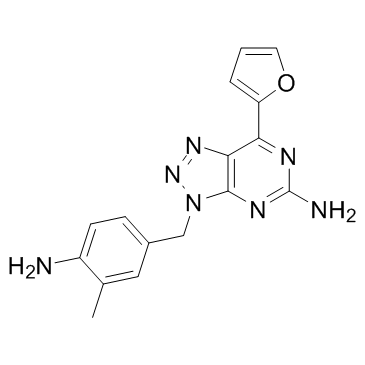
Vipadenant
CAS No. 442908-10-3
Vipadenant( BIIB-014 | BIIB 014 | BIIB014 )
Catalog No. M14510 CAS No. 442908-10-3
A potent and selective A2A adenosine receptor with Ki of 1.3 nM.
Purity : >98% (HPLC)
 COA
Datasheet
HNMR
HPLC
MSDS
Handing Instructions
COA
Datasheet
HNMR
HPLC
MSDS
Handing Instructions
| Size | Price / USD | Stock | Quantity |
| 1 mL x 10 mM in DMSO | 216 | In Stock |


|
| 2MG | 29 | In Stock |
|
| 5MG | 45 | In Stock |
|
| 10MG | 69 | In Stock |
|
| 25MG | 126 | In Stock |
|
| 50MG | 206 | In Stock |
|
| 100MG | 306 | In Stock |
|
| 200MG | 436 | In Stock |
|
| 500MG | Get Quote | In Stock |
|
| 1G | Get Quote | In Stock |
|
Biological Information
-
Product NameVipadenant
-
NoteResearch use only, not for human use.
-
Brief DescriptionA potent and selective A2A adenosine receptor with Ki of 1.3 nM.
-
DescriptionA potent and selective A2A adenosine receptor with Ki of 1.3 nM; displays 50-fold selectivity over A1 and A2B, and no activity against A3, P450 isoforms and hERG; shows excellent preclinical pharmacokinetics, and demonstrates strong oral activity in commonly used models of Parkinson's disease.(In Vivo):Vipadenant (0.3-30 mg/kg) produces a dose-dependent reduction in catalepsy. Vipadenant (10 mg/kg) does not produce any statistically significant dyskinetic episodes in 6-OHDA-lesioned rats during a 19-day dosing regimen. In the mouse and rat haloperidol-induced hypolocomotion models, vipadenant has a minimum effective dose of 0.1 and 1 mg/kg, respectively. Vipadenant (3 and 10 mg/kg, p.o.) is able to increase contralateral rotations in 6-OHDA lesioned rats.
-
In Vitro——
-
In VivoVipadenant (0.3-30 mg/kg) produces a dose-dependent reduction in catalepsy. Vipadenant (10 mg/kg) does not produce any statistically significant dyskinetic episodes in 6-OHDA-lesioned rats during a 19-day dosing regimen. In the mouse and rat haloperidol-induced hypolocomotion models, vipadenant has a minimum effective dose of 0.1 and 1 mg/kg, respectively. Vipadenant (3 and 10 mg/kg, p.o.) is able to increase contralateral rotations in 6-OHDA lesioned rats.
-
SynonymsBIIB-014 | BIIB 014 | BIIB014
-
PathwayApoptosis
-
TargetAdenosine Receptor
-
RecptorA1|A2A|A3
-
Research AreaNeurological Disease
-
Indication——
Chemical Information
-
CAS Number442908-10-3
-
Formula Weight321.3366
-
Molecular FormulaC16H15N7O
-
Purity>98% (HPLC)
-
SolubilityDMSO: ≥ 31 mg/mL
-
SMILESNC1=NC(C2=CC=CO2)=C(N=NN3CC4=CC=C(N)C(C)=C4)C3=N1
-
Chemical Name3H-1,2,3-Triazolo[4,5-d]pyrimidin-5-amine, 3-[(4-amino-3-methylphenyl)methyl]-7-(2-furanyl)-
Shipping & Storage Information
-
Storage(-20℃)
-
ShippingWith Ice Pack
-
Stability≥ 2 years
Reference
1. Gillespie RJ, et al. J Med Chem. 2009 Jan 8;52(1):33-47.
2. Pinna A. Expert Opin Investig Drugs. 2009 Nov;18(11):1619-31.
3. Brooks DJ, et al. Clin Neuropharmacol. 2010 Mar-Apr;33(2):55-60.
molnova catalog



related products
-
N6-Cyclohexyladenosi...
An adenosine A1 receptor agonist (EC50= 8.2 nM).
-
A2B receptor antagon...
A2B receptor antagonist 2 is an antagonist of adenosine receptor A2B (Ki = 2.30 μM for rA1, 6.8 μM for rA2A, 3.44 μM for hA2B).
-
Adenosine A1 recepto...
Adenosine A1 receptor activator T62 is an allosteric enhancer of adenosine A1 receptor, and it produces antinociception in animal models of acute pain and also reduces hypersensitivity in models of inflammatory and nerve-injury pain[2][3].
