


 Cart
Cart
 sales@molnova.com



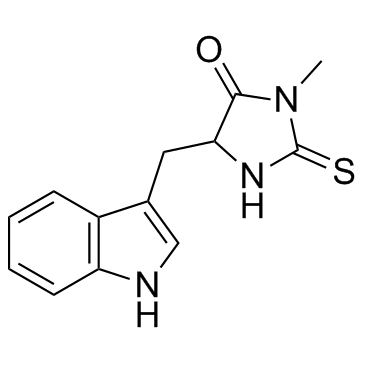
Necrostatin-1
CAS No. 4311-88-0
Necrostatin-1( Nec-1 )
Catalog No. M14462 CAS No. 4311-88-0
Necrostatin-1 is a specific RIP1 inhibitor and inhibits TNF-α-induced necroptosis with EC50 of 490 nM.
Purity : >98% (HPLC)
 COA
Datasheet
HNMR
HPLC
MSDS
Handing Instructions
COA
Datasheet
HNMR
HPLC
MSDS
Handing Instructions
| Size | Price / USD | Stock | Quantity |
| 1 mL x 10 mM in DMSO | 46 | In Stock |


|
| 5MG | 29 | In Stock |
|
| 10MG | 43 | In Stock |
|
| 25MG | 71 | In Stock |
|
| 50MG | 107 | In Stock |
|
| 100MG | 166 | In Stock |
|
| 200MG | 245 | In Stock |
|
| 500MG | 411 | In Stock |
|
| 1G | Get Quote | In Stock |
|
Biological Information
-
Product NameNecrostatin-1
-
NoteResearch use only, not for human use.
-
Brief DescriptionNecrostatin-1 is a specific RIP1 inhibitor and inhibits TNF-α-induced necroptosis with EC50 of 490 nM.
-
DescriptionNecrostatin-1 is a specific RIP1 inhibitor and inhibits TNF-α-induced necroptosis with EC50 of 490 nM.
-
In Vitro——
-
In Vivo——
-
SynonymsNec-1
-
PathwayApoptosis
-
TargetTNF
-
RecptorRIP1
-
Research AreaNeurological Disease
-
Indication——
Chemical Information
-
CAS Number4311-88-0
-
Formula Weight259.33
-
Molecular FormulaC13H13N3OS
-
Purity>98% (HPLC)
-
SolubilityDMSO: 51 mg/mL warmed (196.66 mM)
-
SMILESO=C(C(CC1=CNC2=C1C=CC=C2)N3)N(C)C3=S
-
Chemical Name5-(1H-indol-3-ylmethyl)-3-methyl-2-thioxo-4-imidazolidinone
Shipping & Storage Information
-
Storage(-20℃)
-
ShippingWith Ice Pack
-
Stability≥ 2 years
Reference
1.Han W, et al. Apoptosis. 2009 May;14(5):674-86.
molnova catalog



related products
-
Atibuclimab
Atibuclimab is a chimeric monoclonal antibody targeting CD14, consisting of a mouse variable region and a human IgG4 Fc region.
-
Physcion 8-O-β-D-glu...
Physcion 8-O-β-D-glucopyranoside has anti-inflammatory and anti-cancer activities. Physcion 8-O-β-D-glucopyranoside can be used in studies about common malignancy cancer.
-
Armepavine
Armepavine exerted both in vitro and in vivo antifibrotic effects in rats, with inhibition of NF-κB, JunD and C/EBP? pathways.
