


 Cart
 sales@molnova.com




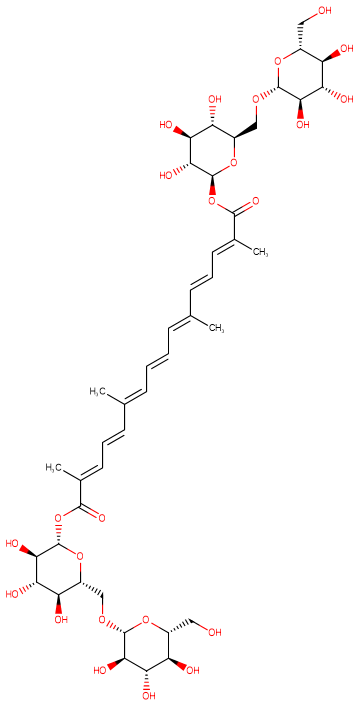
Crocin
CAS No. 42553-65-1
Crocin( —— )
Catalog No. M14446 CAS No. 42553-65-1
General descriptionA highly unsaturared diterpene dicarboxylic acid ester found in saffron.
Purity : >98% (HPLC)
 COA
Datasheet
HNMR
HPLC
MSDS
Handing Instructions
| Size | Price / USD | Stock | Quantity |
| 1 mL x 10 mM in DMSO | 57 | In Stock |


|
| 5MG | 30 | In Stock |
|
| 10MG | 41 | In Stock |
|
| 25MG | 64 | In Stock |
|
| 50MG | 88 | In Stock |
|
| 100MG | 114 | In Stock |
|
| 200MG | Get Quote | In Stock |
|
| 500MG | Get Quote | In Stock |
|
| 1G | Get Quote | In Stock |
|
Biological Information
-
Product NameCrocin
-
NoteResearch use only, not for human use.
-
Brief DescriptionGeneral descriptionA highly unsaturared diterpene dicarboxylic acid ester found in saffron.
-
DescriptionGeneral descriptionA highly unsaturared diterpene dicarboxylic acid ester found in saffron.
-
In VitroCell Viability Assay Cell Line:HCT116 Concentration:0, 50, 100, 150, 200, 250, 300, 350, 400, and 450 μM Incubation Time:24 h Result:Weakened the cell vitality in a concentration-dependent manner.Apoptosis Analysis Cell Line:HCT116 Concentration:150, 200 μM Incubation Time:24 hResult:Facilitated apoptosis of HCT-116 cells in a concentration-dependent manner.Abated the colony number and downregulated the positive expression of Ki-67.Western Blot Analysis Cell Line:HCT116 Concentration:150, 200 μM Incubation Time:24 h Result:Decreased the levels of p-JAK2, p-STAT3, and p-ERK, as well as the ratios of p-JAK2/JAK2, p-STAT3/STAT3, and pERK/ERK.
-
In VivoAnimal Model:Bleomycin-induced pulmonary fibrosis in rat Dosage:20 mg/kg Administration: p.o.Result:Reduced the expression of TLR4 and IL-10.Reduced the expression of TNF-α and TGF-β1.
-
Synonyms——
-
PathwayOthers
-
TargetOther Targets
-
RecptorOthers
-
Research AreaOther Indications
-
Indication——
Chemical Information
-
CAS Number42553-65-1
-
Formula Weight976.96
-
Molecular FormulaC44H64O24
-
Purity>98% (HPLC)
-
SolubilityDMSO: 10 mM
-
SMILESC/C(=C\C=C\C=C(\C=C\C=C(\C(=O)O[C@@H]1O[C@@H]([C@H]([C@@H]([C@H]1O)O)O)CO[C@@H]2O[C@@H]([C@H]([C@@H]([C@H]2O)O)O)CO)/C)/C)/C=C/C=C(/C(=O)O[C@@H]3O[C@@H]([C@H]([C@@H]([C@H]3O)O)O)CO[C@@H]4O[C@@H]([C@H]([C@@H]([C@H]4O)O)O)CO)\C
-
Chemical Name——
Shipping & Storage Information
-
Storage(-20℃)
-
ShippingWith Ice Pack
-
Stability≥ 2 years
Reference


-
8-Hydroxygenistein
8-Hydroxygenistein (8-OHG) is an antioxidant that can effectively scavenge nitric oxide (NO) and superoxide anion (O??). 8-Hydroxygenistein belongs to ortho-dihydroxy isoflavones (ODI) and is abundantly present in dark soy sauce and light soy sauce. Its antioxidant activity is stronger than that of its parent compound genistein. The content of 8-Hydroxygenistein is positively correlated with the antioxidant capacity of soy sauce (r = 0.959), and it remains highly stable even after being heated in boiling water for 60 minutes. During the brewing and storage of soy sauce, 8-Hydroxygenistein effectively prevents oxidative damage, making it promising for use in food antioxidant research.
-
Fuscaxanthone C
Fuscaxanthone C is a natural product from Garcinia mangostana.
-
2-Hydroxyemodin
2-Hydroxyemodin is an active metabolite of emodin in the hepatic microsomes. Emodin is an anthraquinone present in fungal metabolites and constituent of rhubarb. 2-Hydroxyemodin proves to be mutagenic to Salmonella typhimurium TA1537 in the absence of activation system.
